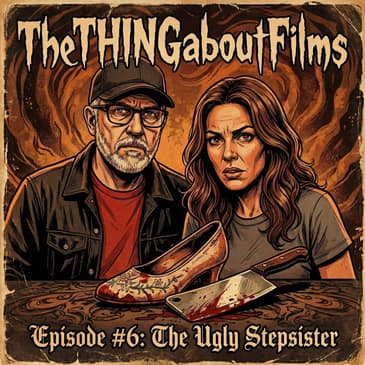
So, you bought a ticket for a fairy tale. But you got a bone chisel.
This week Ambrose and Jessica (filling in for Kelly, who's recovering from surgery — get well soon!) crawl down into the Critic's Crypt to break down The Ugly Stepsister (2025) — Emily Blitchfield's debut feature that takes the Brothers Grimm version of Cinderella and drags it straight into full-on body horror territory.
Think less glass slipper, more hammer and chisel. Less pumpkin carriage, more tapeworm extraction.
What We Cover
- Who is Elvira — and why she's the most relatable character in any Cinderella story ever made
- Why Agnes (Cinderella) is not the pure, helpless good girl you grew up with
- The rotting body in the spare room and what it says about money, class, and survival
- Dr. Esthetique's Institute — the procedures, the practical effects, and the foley work that will make you never eat celery again
- The tapeworm scene, the extraction scene, and the Sundance vomit incident
- The toe-chopping finale — and the tragically funny mistake that makes it worse
- How this compares to The Substance (and why this one is angrier and grimier)
- The Oscar-nominated makeup work and how they made a classically trained dancer look "aggressively average"
- What the film is actually saying about the beauty industry, eating disorders, and the economics of marriage
Content warning: graphic body horror, surgical procedures, eating disorder themes, blood, and a tapeworm extraction that one Sundance audience member did not survive emotionally.
Mentioned This Episode
- The Substance (2024)
- Raw (2016) — dir. Julia Ducournau
- Crash (1996) — dir. David Cronenberg
- Dead Ringers (1988) — dir. David Cronenberg
- Possession (1981)
- The Fly (1986)
- A Rose for Emily — William Faulkner
- Thelma & Louise (1991)
- William Castle (gimmick marketing legend)
- Jacques Joseph — pioneered modern rhinoplasty in the late 19th century
- The 1899 Paris trend of sewing hair into eyelids for "permanent" lash extensions (yes, it was real)
EPISODES FM - _https://episodes.fm/1809836198?view=apps&sort=popularity
Swift - https://www.swiftenergy.gg/products/tropicrush?ref=svalxxsi
Facebook Group Page - https://www.facebook.com/groups/1263899825130479
Blue Sky - https://bsky.app/profile/thethingaboutfilms.bsky.social
Instagram - https://www.instagram.com/thethingaboutfilms/
TikTok - https://www.tiktok.com/search?q=TheTHINGaboutFilms&t=1754605765379
Ambrose: Okay, welcome back. Pull up a chair. And check if your doors are locked. Dim the lights — like, way down.
Jessica: Way down. Hey, everyone. I’m filling in for Kelly this week again. We have a bit of sad news. Kelly had to have surgery to have her tonsils removed. So she will be sidelined for a couple of weeks.
Ambrose: Yeah, but don’t worry the show will go on and we wish Kelly a speedy recovery.
Jessica: Yes Indeed.
Ambrose: Alright. So we're shifting gears tonight. Usually it's kinda bright in here. "Safe daytime TV" energy, right?
Jessica: Right. Not tonight.
Ambrose: Nope. Tonight it's like — we're sitting around a campfire at 2 a.m. or —
Jessica: Huddled in the back of some really creepy old theater.
Ambrose: Exactly. Long after the popcorn's gone stale. And we're about to watch something that is gonna mess us up a little.
Jessica: It's a huge shift in vibe for us.
Ambrose: Oh, for sure.
Jessica: We are leaving "comfortable" behind and going headfirst into… like… full body-horror mode.
Ambrose: Yep. And you know that specific kind of silence in a theater when the audience realizes they’ve been tricked?
Jessica: Oh my God, yes. It’s that “hold your breath” moment.
Ambrose: Right. You buy a ticket for a fairy tale. You sit down expecting the glass slipper, the pumpkin carriage, a catchy little song about dreams coming true.
Jessica: The usual childhood comfort food.
Ambrose: Exactly. And then, like ten minutes in, you realize you’re not watching a fantasy at all.
Jessica: Nope. You're watching a medical dissection.
Ambrose: Yep.
Jessica: And with this movie? That silence hits right around the first incision.
Ambrose: Yes. The first of many. Many. Many.
Jessica: And it's not just a tone shift — it's a full betrayal of what you thought you signed up for.
Ambrose: Yeah I have to say “Betrayal” is definitely the perfect word for this. Because today we’re talking about the 2025 release, The Ugly Stepsister. A film that takes—
Jessica: A childhood comfort and drags it into a medical dungeon.
Ambrose: Exactly. And if you're listening right now thinking "Oh great, another Cinderella remake, I've seen this a thousand times" —
Jessica: Trust us. You haven't.
Ambrose: No. Stop folding laundry for a second. Stop the car. Whatever you’re doing—lock in. Because this takes the Brothers Grimm version, which, let’s be real, was already dark.
Jessica: Extremely dark. Those Grimm stories were not written for the nursery.
Ambrose: Right. But this movie grabs that darkness and yanks it into modern, super graphic horror that feels less like a cartoon and more like Saw meets Marie Antoinette.
Jessica: That is… painfully accurate.
Ambrose: We're not talking magic wands today. We're talking bone chisels. We're talking parasites.
Jessica: Tapeworms, specifically. Ugh.
Ambrose: Yep. We're talking desperation that makes you physically cringe —
Jessica: And way more psychological trauma than you should ever get from a story about a lost shoe.
Ambrose: Buckets of it. So, premise: this movie takes the perspective of Elvira—the so-called ugly stepsister—and turns her into the protagonist of this absolute body-horror nightmare. It’s chaotic, it’s gross, and it’s surprisingly deep.
Jessica: Ooooh VERY deep.
Ambrose: We're gonna get into the gore, the pitch-black satire, and why this movie had someone literally vomiting in the aisles at Sundance.
Jessica: There's a lot to get into. And just to be clear — this isn't just a plot recap.
Ambrose: Right.
Jessica: We're talking how it drags the wellness industry, the economics of marriage in a patriarchal monarchy, and the technical wizardry of making a healthy actress look physically repulsive using practical effects.
Ambrose: It's a heavy one. So… yeah. Let's just jump in.
Jessica: Let's do it.
Ambrose: Okay, first — let's set the table. What world are we in? Who are we following? Because the setup really matters with this one.
Jessica: So we're in the fictional Kingdom of Sweelandia. Visually, it's giving full period piece. Like, 18th or 19th century.
Ambrose: Sooo big gowns, tons of candlelight.
Jessica: Yes. Carriages. It’s very classical.
Ambrose: But psychologically? It feels insanely modern. Like you're trapped inside a teenage girl's brain in 2025.
Jessica: That mismatch is basically the whole identity of the movie. The director, Emily Blitchfield, builds this world that feels stuck in time. You've got corsets and horses, sure — but the anxiety? The body obsession? That's pure Gen Z, pure TikTok-era panic.
Ambrose: So let's start with our main character: Elvira, played by Leah Myron. In basically every version we've seen before, the stepsisters are just… mean.
Jessica: Yeah. They're caricatures.
Ambrose: They exist to make Cinderella look better. But Elvira?
Jessica: Elvira is… us.
Ambrose: She is. And that's what's so brutal about it. She's got acne. Massive metal braces.
Jessica: And she's slightly chubby — but not in a goofy, slapstick way.
Ambrose: No. It feels real.
Jessica: And that's why the makeup team deserves credit. They didn't do "monster ugly." They did "awkward ugly."
Ambrose: Ahhh yeah — awkward TEENAGE ugly.
Jessica: Exactly. Because Leah Myron is actually a classically trained dancer.
Ambrose: Oh — really?
Jessica: Yeah. Super fit, super poised in real life. So they used subtle prosthetics to tweak her jaw just slightly —
Ambrose: Wow.
Jessica: — give her that mouth-breather resting face.
Ambrose: Yes! It's that weird uncanniness of puberty. When your face doesn't match your skull yet.
Jessica: Exactly. And the acne wasn't just painted dots. It looked painful. Cystic.
Ambrose: Yeah, it looked inflamed.
Jessica: And that texture matters — because it instantly isolates her in this world where everyone's supposed to have porcelain skin. But psychologically? Elvira's fascinating because she —
Ambrose: Believes the fairy tale.
Jessica: Yes. She's the only person in the whole movie who actually thinks she's in a romantic fantasy.
Ambrose: So she's a romantic, not a villain. She's not plotting because she hates Cinderella — she's plotting because she's desperate for someone to love her.
Jessica: Yes. She just wants to be loved.
Ambrose: And she reads this terrible poetry from Prince Julian and genuinely thinks he's her soulmate.
Jessica: Oh God. The poetry.
Ambrose: It is so bad.
Jessica: We have to talk about him later. But falling for a guy entirely based on his awful writing? Most teenage thing ever.
Ambrose: Truly. That one line — "My heart breaks. I'd rather die than to my heart lie and be with one I do not love."
Jessica: That is 14-year-old edgelord poetry.
Ambrose: Yes. But Elvira eats it up like it's —
Jessica: The Martyr. Because she’s projecting. She needs him to be deep because she needs her suffering to mean something.
Ambrose: Oh… that actually makes so much sense.
Jessica: Right? Because if he's just a shallow idiot, then the corset training, the hunger, the bullying — it's all for nothing. So she builds this whole fantasy just to survive how she feels about herself.
Ambrose: Which brings us to the foil. Agnes. Cinderella.
Jessica: This is where my jaw hit the floor.
Ambrose: This is not the Cinderella you grew up with. Agnes is beautiful — blonde, ethereal, like a painting — but she is not helpless.
Jessica: Not even a little. Agnes is cunning.
Ambrose: So cunning.
Jessica: She's arrogant. Strategic. And the movie makes it really clear she uses her beauty like a weapon because it's the —
Ambrose: Only weapon she has.
Jessica: Exactly. The film basically says Cinderella isn't a victim of her stepfamily. She's a victim of her own ambition.
Ambrose: Or maybe just a victim of the market.
Jessica: I would call her a market analyst.
Ambrose: Okay, I like that.
Jessica: She sees the chessboard. She knows she has one asset: her face.
Ambrose: Yeah.
Jessica: And she treats it like a depreciating asset she has to sell at the top of the market. There's that scene where she stares in the mirror and it's not vanity — it's appraisal.
Ambrose: Yes. Like she's checking a car engine before selling it.
Jessica: Exactly. Cold. And Thea Sophie Loch Ness plays her with this detached precision. She's not the pure "good girl" archetype.
Ambrose: No. They imply she's having a secret relationship with a stable boy, which changes everything.
Jessica: Oh completely. She doesn't want the prince for love — he's an escape route. It's a transaction.
Ambrose: And it's tragic, because she actually has love. Real love. But she throws it away because she —
Jessica: Knows love doesn't pay the mortgage. In this version, Cinderella is the mercenary.
Ambrose: It's cynical, but honestly? It feels way more real.
Jessica: And speaking of money — we have to talk about the mom. Rebecca. Played by Ann Dahl Torp.
Ambrose: Critics have compared her to like an evil Kris Jenner. Or a hardcore dance mom.
Jessica: And it fits.
Ambrose: Now, in cartoons, the stepmother is just evil because the story needs a villain. But here, Rebecca is terrified.
Jessica: Yes. She's financially desperate.
Ambrose: She's basically the CEO of a failing company.
Jessica: And that's the trigger for the whole horror show. She marries Otto — Agnes's dad — thinking he's rich.
Ambrose: She thinks she secured the bag.
Jessica: She does. And then — at the wedding dinner — he has a heart attack and faceplants into his meal.
Ambrose: I'm not even exaggerating — he fully goes down face-first into the food. And just like that, the whole "we're saved" plan collapses.
Jessica: Exactly. It's grimly funny. Almost slapstick.
Ambrose: Yeah.
Jessica: But the real horror is what comes after. She goes through his papers and finds out Otto was broke. Penniless. So she refuses to pay for a funeral.
Ambrose: This detail haunted me. They just… leave him there.
Jessica: Yes. They leave his body in a room in the house for the entire movie. The whole runtime. He's literally rotting in the spare room because they can't afford to bury him.
Ambrose: That is so macabre. It's like William Faulkner or something.
Jessica: Very "A Rose for Emily."
Ambrose: Yes! The body becomes this physical, rotting symbol of their financial failure.
Jessica: And it creates a literal stink in the house. They're burning incense, covering their noses. And the fact that they just shut the door tells you everything about Rebecca.
Ambrose: Out of sight, out of mind.
Jessica: Exactly. She compartmentalizes reality. If the door's closed, the rot isn't happening.
Ambrose: Wow.
Jessica: Same logic later — "if we break Elvira's nose, she isn't ugly."
Ambrose: It sets the stakes fast. In this society, women are basically commodities.
Jessica: Yeah, they're treated like property. No real control over their lives.
Ambrose: And no way to make money. The only plan is to "sell" Elvira to the prince.
Jessica: Exactly.
Ambrose: And it's not just vanity — they're doing it to survive.
Jessica: If they fail, they starve. Or end up like the dad — rotting in a room, forgotten.
Ambrose: It takes "beauty is pain" and makes it literal. Which brings us to the meat grinder. Or as I call it — the Institute.
Jessica: This is where it shifts from tense period drama into full-on body horror.
Ambrose: Elvira gets sent to a finishing school, but it's not curtsies and books-on-your-head.
Jessica: No. It's a clinic run by the wonderfully named Dr. Esthetique.
Ambrose: A name that's just on-the-nose enough to work.
Jessica: And he's a complete sadist. But the setting shift matters too — the visuals change.
Ambrose: Totally.
Jessica: The house is warm — candlelight, deep shadows, rich fabrics. But the Institute? Cold. Sterile. The light turns sickly, almost green.
Ambrose: It feels like an asylum.
Jessica: It feels like a hospital before anyone knew what cleanliness was.
Ambrose: Okay — procedures. Because this is all practical effects. And it is graphic. Squirm-in-your-seat graphic. We have to start with the rhinoplasty.
Jessica: Oh man. The nose job.
Ambrose: Elvira has a bump. A normal human nose bump. And Rebecca's like, "Nope. Gone. Today."
Jessica: Not in Sweelandia.
Ambrose: What do they use in this movie?
Jessica: A hammer and a chisel.
Ambrose: A chisel. Like she's a block of marble.
Jessica: Yup. And she's fully awake.
Ambrose: Oh, damn.
Jessica: She’s pinned to a wooden chair. And assistants are holding her down. And the doctor breaks the nasal bones. You hear the crunch.
Ambrose: I'm cringing just thinking about it. The sound in that scene — I swear that's what earned the R rating. It's not just what you see. It's what you hear.
Jessica: Exactly. And the audio is punishing.
Ambrose: I read the production notes about the foley work. You know what they used for the nose-breaking sound?
Jessica: I feel like I don't want to know… but tell me.
Ambrose: Wet celery snapping right next to the mic, layered with a walnut being crushed in a metal vise.
Jessica: That is vile.
Ambrose: And they combined them to get that wet crack of cartilage and bone.
Jessica: That’s horrifyingly creative. And the scary part is — historically? It's not totally made up.
Ambrose: Wait — really?
Jessica: Yeah. The Tagliacosi method of nasal reconstruction existed in the 16th century.
Ambrose: You're kidding.
Jessica: Nope. Cosmetic rhinoplasty — like reducing a dorsal hump for beauty — wasn't really standardized until the late 19th century by Jacques Joseph.
Ambrose: Okay then.
Jessica: And what the movie does is take those kinds of tools — chisels, bone saws — and uses them with the brutality of a torture chamber.
Ambrose: And she's awake for all of it. Dr. Esthetique barely uses any numbing because the pain —
Jessica: Is part of the payment.
Ambrose: Right.
Jessica: The movie's basically saying: if you don't suffer for the beauty, you didn't earn it.
Ambrose: And after, she has to wear this giant brass face brace to keep the nose set. She looks like a teenage Dr. Doom walking around.
Jessica: It's such a perfect image. Beauty as construction. She's literally being scaffolded like a building.
Ambrose: Yeah.
Jessica: But honestly? The nose was bad… the eyes were worse.
Ambrose: The eyelashes. Okay — walk me through this, because I'm pretty sure my brain tried to delete it for self-defense.
Jessica: So, this takes place before cosmetic lash glue is a thing. So if you want thicker lashes to attract a prince —
Ambrose: I already hate this
Jessica: You sew them.
Ambrose: Wow.
Jessica: Yup. Horse hair. A curved metal needle. Sewed directly into the eyelid skin.
Ambrose: That's just pure sadism.
Jessica: And it hits that primal reflex — because we're all wired to protect our eyes.
Ambrose: I'm blinking just hearing you say it.
Jessica: And watching the needle thread through the lid margin is agonizing.
Ambrose: Please tell me that part was made up.
Jessica: Believe it or not — no. It was real.
Ambrose: That’s just fucking insane.
Jessica: And there was a documented trend around 1899 — reported in major Paris newspapers — of wealthy women sewing hair from their own heads into their eyelids for "permanent" extensions.
Ambrose: Imagine if they used that technique today.
Jessica: I know right. But it led to infections, abscesses, and in some cases, blindness.
Ambrose: And the movie shows that risk. Her eyes are beet red, inflamed, constantly weeping that yellowish fluid. You feel it in your own body.
Jessica: You start rubbing your own eyes like an idiot.
Ambrose: Exactly!
Jessica: And it draws a direct line to now. We don't sew hair in with needles anymore, but we do glue fibers to lash lines with harsh cyanoacrylate adhesives. That can cause chemical burns.
Ambrose: Well, that’s got to be less painful. Right.
Jessica: You would think. But we do threads. We scrape out buccal fat. So the tools changed — harm didn't.
Ambrose: And it's all so unnecessary. She doesn't need any of it. But she's convinced she does. Which takes us straight to the tapeworm.
Jessica: The ultimate diet plan.
Ambrose: Elvira wants to lose weight. She loves pastries — extremely relatable. She sneaks little cakes, but she thinks she has to be tiny to fit the gowns for the prince.
Jessica: So she makes a choice.
Ambrose: She voluntarily swallows a tapeworm egg.
Jessica: Yup. And the sound design becomes a character. The gurgling.
Ambrose: Damn that is just awful. Wet, squelchy bubbling that follows her around. Once it starts, you hear it whenever it's quiet.
Jessica: And Emily Blitchfield has talked about that choice — she describes the tapeworm like Elvira's secret pet.
Ambrose: A pet that is so messed up.
Jessica: But it's a perfect metaphor for eating disorders. Sometimes the disease feels like a companion. It becomes you and the disease versus the world. A secret you share with yourself.
Ambrose: That's so dark… but it fits. She's nurturing something inside her that's literally eating her alive.
Jessica: Exactly.
Ambrose: She swallows the egg and the movie makes you wait. Forces you to just sit there while it grows.
Jessica: And later, the tapeworm effects are practical too. No CGI. It has weight. It has slime.
Ambrose: Which brings us to the extraction.
Jessica: This is the scene that got instantly infamous on the festival circuit.
Ambrose: The vomit moment.
Jessica: Allegedly, at Sundance, someone in the front row threw up during this scene.
Ambrose: Which is honestly the highest compliment a horror director can receive.
Jessica: Full William Castle energy.
Ambrose: It's a badge of honor. So — setup: Elvira realizes the tapeworm is killing her. She's weak. Pale. She needs it out now.
Jessica: She takes a strong liquid antidote —
Ambrose: — and immediately starts to heave.
Jessica: And it's not just a little bile situation. She vomits up the head of the parasite —
Ambrose: But it doesn't come all the way out. It's latched inside her stomach.
Jessica: So Alma — her younger sister, the quiet moral compass of the whole movie — has to help.
Ambrose: So, she grabs it with her bare hand.
Jessica: She reaches into her sister's mouth, grabs this huge gelatinous worm mass, and starts pulling.
Ambrose: It's like that clown handkerchief trick from hell. It just keeps coming.
Jessica: Hand over hand. It's endless.
Ambrose: It’s a thick, pale, intestine-looking horror. And it reminds me of the Alien's chestburster scene, and the vomit sequences in Cronenberg's The Fly. That "body turning inside out" terror — where the line between you and what's inside you just collapses.
Jessica: And it's the physical version of everything she's been forced to swallow. She's violently purging the beauty standard.
Ambrose: Exactly. But the movie isn't done punishing you. Because we still have a ball to get to… and a shoe to fit.
Jessica: The grim finale. They go back to the Grimm ending. The prince arrives, the slipper comes out, and it doesn't fit Elvira.
Ambrose: In the animated version, the shoe doesn't fit and that's that. Mild disappointment.
Jessica: Right. But in Grimm — and in this movie — Rebecca doesn't accept defeat. She walks over and hands Elvira a knife.
Ambrose: And historically, Cinderella stories show up everywhere — Chinese versions, Scottish versions — and physical mutilation is a recurring element. That brutal idea that a woman has to cut herself down to fit a role built for her —
Jessica: Yeah.
Ambrose: It's ancient.
Jessica: So Elvira takes a heavy meat cleaver and a chunk of firewood, sets the blade on her foot, and uses the wood like a hammer to chop off her toes.
Ambrose: It's desperation at maximum volume. She willingly mutilates herself. And then — this is where the pitch-black comedy hits — she realizes she made a huge mistake.
Jessica: Right. She cuts the toes off the wrong foot.
Ambrose: It's bleak and hilarious and devastating all at once.
Jessica: And blood is everywhere. Screaming. And then she looks at the slipper and goes, "Oh no… it's the left shoe. I just destroyed the right foot."
Ambrose: And Rebecca doesn't blink.
Jessica: Nope. She’s stone cold.
Ambrose: Right. No comfort. No motherly moment. She sedates Elvira, picks up the cleaver, and chops the correct toes off herself.
Jessica: It's horrific efficiency.
Ambrose: Talk about a can-do manager. "We have a deadline, let's move."
Jessica: And it shows Rebecca has completely disconnected from her daughter's pain. Elvira isn't a person anymore — she's livestock being prepped for market.
Ambrose: And cutting off the parts that don't fit to make the sale. And of course, it's all for nothing.
Jessica: Right. Because the prince notices the blood.
Ambrose: Yeah. She's bleeding through the white slipper as she walks to the carriage.
Jessica: And he rejects her immediately. Disgusted.
Ambrose: Which takes us to Segment four: why do we watch this? What is this movie actually saying under all the blood and severed toes?
Jessica: The "beauty meat grinder" metaphor is the obvious one. The film is basically screaming that the modern beauty industry is not about empowerment.
Ambrose: Right — because we love telling ourselves, "I'm doing this for me." Lip filler for me. Botox for me.
Jessica: And the movie's like, "No. You're doing it for a system that hates you." It compares these brutal old-world procedures to our casual modern trends.
Ambrose: Exactly. Like Ozempic. Buccal fat removal. Preventative fillers in your twenties.
Jessica: Exactly. It's holding up a mirror and saying, "Look — we just have better anesthesia now."
Ambrose: The psychology's the same. We're still sitting in chairs, chiseling away at ourselves. Still doing awful things to chase a look.
Jessica: And the movie keeps asking: for what? For the prince.
Ambrose: So, let’s talk Prince Julian — because he is the worst.
Jessica: He's an insufferable misogynist bro.
Ambrose: He treats the royal ball like a cattle market, not a romance.
Jessica: It borders on a trafficking vibe with how the older men talk about the young women. And the best irony? Julian isn't even a catch.
Ambrose: Not at all. He writes god-awful poetry. And they keep showing this detail: his skin is peeling off his face and hands.
Jessica: Yes. It's heavily implied he has a severe late-stage STD. His skin flakes onto his velvet coat.
Ambrose: So all these women are starving, breaking their faces, cutting off their toes… to marry a guy who's contagious and writes bad poems.
Jessica: Exactly. It strips the fairy tale ending away completely. There's no magical prize. The prize is literally a health hazard. And it forces you to ask: why is this the "goal" of their lives?
Ambrose: And it also destroys the whole "inner beauty wins" message.
Jessica: And this is huge. Modern versions teach us: be kind, be good, and you'll eventually win.
Ambrose: But Elvira is kind. She's a romantic. She has a good heart.
Jessica: But it doesn't save her from the cleaver.
Ambrose: Nope. In that society, goodness doesn't matter. Only the outside matters.
Jessica: It's bleak. But the movie does offer a little hope at the end.
Ambrose: Ahhh yes. The sisterhood angle.
Jessica: The younger sister is the real hero. She rejects the beauty cult from day one. She watches the nose-breaking, the tapeworm extraction, the toe-chopping — and she's like, "You people are not okay."
Ambrose: Yeah. You’re “clinically insane.”
Jessica: And the ending isn't a royal marriage. It's the sisters escaping together.
Ambrose: They steal the mother's jewelry and run into the woods.
Jessica: It's basically a period-piece Thelma and Louise — minus the cliff. They choose each other over the system.
Ambrose: I love that. Okay —production. Who made this madness?
Jessica: This is Emily Blitchfield's debut feature —
Ambrose: A debut that is wildly ambitious.
Jessica: She came out swinging. She's said in interviews she has a personal connection to the story — growing up feeling awkward, feeling like she had big feet, relating more to the ugly stepsister than Cinderella.
Ambrose: That’s a great point of view. Because honestly, we've all felt like the ugly stepsister at some point. That "I don't fit the mold" feeling is just… universal.
Jessica: Exactly. And she cited directors like David Cronenberg — specifically Crash — and Julia Ducournau's Raw as big inspirations.
Ambrose: Oh, I can totally see that. You can feel the Raw DNA — the coming-of-age pain mixed with body-horror chaos.
Jessica: And we have to circle back to those "invisible" prosthetics. Because Leah Myron is very fit.
Ambrose: Yes, she was a professional dancer. So to make her look like the awkward, chubby sister, they didn't do the lazy teen-movie thing.
Jessica: "Put glasses on her and a messy ponytail."
Ambrose: Exactly. They used detailed silicone prosthetics to change how her face catches light — subtle double chin, thicker neck, overall softer shape.
Jessica: It's reverse beautification. And it's honestly wild how much time and money went into making a beautiful person look aggressively average.
Ambrose: The makeup team led by Thomas Fulberg got an Oscar nomination for that.
Jessica: Which is huge for horror.
Ambrose: And extremely rare. That category usually goes to sci-fi creatures or big aging transformations.
Jessica: So the industry clearly noticed the technical work. And the reception has been wild — 96% on Rotten Tomatoes right now.
Ambrose: Massive critical darling… and also super polarizing for general audiences because the gore is intense. Which led to the genius vomit-bag marketing campaign.
Jessica: Yes. Shudder picked up the distribution rights and released it in theaters with branded vomit bags at the door.
Ambrose: It’s a classic William Castle gimmick. And it worked. It told you immediately: "Hey. This is gonna be an endurance test."
Jessica: And critics keep comparing it to The Substance, but the general consensus is The Ugly Stepsister is nastier and angrier.
Ambrose: Oh I agree. The Substance is sleek. Glossy. Hollywood. It's about fear of aging in a high-def world.
Jessica: This one is grimy. European. Cold. Dirty.
Ambrose: It's like… being cut open with a sterile laser scalpel versus a rusty iron saw.
Jessica: That’s a perfect comparison.
Ambrose: So — gore, characters, social commentary, tapeworms, toes, Oscar-nominated makeup, wet celery foley… Did I miss anything?
Jessica: Nope. You got it all of it.
Ambrose: But is that the end of it?
Jessica: Not even close.
Ambrose: That’s because we haven't even hit the final verdict.
Jessica: Exactly. And we still have to answer the big question: is this a masterpiece of feminist horror… or is it just torture porn in a pretty tiara?
Ambrose: That's the question. And we're answering it right now — because we're heading down into the Critic's Crypt.
Jessica: Lead the way Crypt Boy.
[Ambrose] Okay—back down in the crypt. [inhales] Why does it always smell like wet stone and regret down here?
[Jessica] That’s because you insist on coming back. Like it’s your favorite restaurant.
[Ambrose] It is. The ambience is unbeatable. Also, my allergies are acting up, which feels… disrespectful, honestly. Down here? Really?
[Jessica] Your body’s like, “Cool, let’s sneeze in the haunted basement.” Perfect timing.
[Ambrose] If I start coughing, just tell everyone it was the spirits. Make it dramatic.
[Jessica] Oh I will. I’ll be like, “He gave his life for cinema.” Okay. So. Let’s do this before something crawls out of a wall.
[Ambrose] Okay. Deal. Let's start first with the pros—because there’s a lot that works with this movie.
[Jessica] Yes. Let’s start with the performances. Because Leah Myren as Elvira? Is insane, because she’s doing an insane amount of work.
[Ambrose] Exactly. Like physically. Because half the movie she’s screaming, crying, or violently vomiting.
[Jessica] And the wild part is she still keeps Elvira likable. Like you’re rooting for her even when she’s making the most unhinged choices.
[Ambrose] That’s the thing. Because on paper you’d be like, “Girl, stop.” But she makes it feel like desperation, not stupidity.
[Jessica] Exactly. And that’s why the body horror lands. If you didn’t care about her, it would just be gross for gross’s sake. But she plays her emotionally vulnerable, so the gore hits harder.
[Ambrose] And you get protective. Like you’re watching through your fingers going, “No—don’t do that.”
[Jessica] Yes. You know when you want to reach into the screen and physically stop someone? That’s me during the egg moment. Like please. Please don’t swallow that. [laughs]
[Ambrose] I was begging the TV. It didn’t listen. And then we have Thea Sofie Loch Ness as Agnes—she plays “cold” so well.
[Jessica] She does. And it’s not cartoon villain cold. It’s survival cold. And you understand why she’s sharp.
[Ambrose] Because the world’s been punching down on her.
[Jessica] Exactly. And then Ann Dahl Torp as Rebecca… she makes a monster who feels uncomfortably human.
[Ambrose] It’s that “banality of evil” vibe. She’s not cackling like a witch. She’s just doing the math like, “We need money, so I will break your nose.”
[Jessica] Right. Because it’s just business to her. And that kind of evil exists in real life, which makes it hit even harder.
[Ambrose] Yeah. It’s not fairytale evil. It’s paperwork evil.
[Jessica] And visually, the movie is disgusting in the best way. It’s so claustrophobic—those extreme close-ups where you can see pores, sweat, blood.
[Ambrose] Because you feel trapped in that rotting house with them. And the contrast is nasty: gorgeous silk gowns… and then the corpse room down the hall like it’s normal.
[Jessica] That’s the theme in one image. The surface is shiny. Behind the door is rot.
[Ambrose] Okay. Let’s talk cons now. Because I know the biggest one people always bring up.
[Jessica] Yeah. The “it’s too much” complaint. That the gore crosses into gratuitous.
[Ambrose] And I get why they say it.
[Jessica] I get it also. And let’s take that tapeworm scene—does it need to go on that long in one stretch? Uh Maybe not.
[Ambrose] But also… isn’t that kind of the point?
[Jessica] Yes, but listen—body horror can test your limits without overstaying its welcome. If they trimmed that beat down just a little, you’d keep the impact without sliding into “okay I get it.”
[Ambrose] I hear you. I just think the movie wants you to sit in it. Like if you look away, the movie wins.
[Jessica] You’re so annoying. But yeah, it’s endurance cinema. It’s supposed to make you uncomfortable. It wants you to feel the cost.
[Ambrose] And the Substance comparison is interesting too, because The Substance is about aging.
[Jessica] This one is about adolescence.
[Ambrose] That distinction matters. The Substance is a woman trying to get her youth back. This is a girl trying to become something she never was.
[Jessica] And that teenage desperation is a different horror. It’s messier. Louder. More chaotic.
[Ambrose] Okay, ending—sisters running away.
[Jessica] It’s the only happy ending that makes sense.
[Ambrose] But like… where do they even go? No money, no status without a husband. The whole setup is designed to trap them.
[Jessica] They do have stolen jewelry.
[Ambrose] True. They robbed the house before they bolted.
[Jessica] But bigger than that—they have autonomy. They broke the cycle. They’re not competing for the prince anymore.
[Ambrose] That’s the real win. Not “getting the guy,” but realizing you don’t even want the guy.
[Jessica] They looked at the rigged game and flipped the board over.
[Ambrose] Okay. So what’s the final verdict? Is it a modern classic or something else?
[Jessica] I think it’s a cult classic in the making. It’s too abrasive and too gross for mainstream audiences to fully embrace.
[Ambrose] Yeah, you’re not putting this on for family movie night. Grandma is not surviving the slow-motion toe-chopping scene.
[Jessica Absolutely not. But for hardcore horror fans—people who love Possession or Dead Ringers—this is a feast.
[Ambrose] It’s bold, it’s disgusting, and it actually has something to say. And it made choices. Big choices.
[Jessica] I agree. It’s not shock for nothing. There’s a point under the gross-out.
[Ambrose] Also it guarantees I will never, ever get eyelash extensions for the rest of my life.
[Jessica] Wise choice after those needles.
[Ambrose] One last little gut-punch—because we mentioned the dad’s body in the spare room.
[Jessica] And poor Otto.
[Ambrose] There’s a brief post-credits scene.
[Jessica] There is. And it’s such a nasty final note.
[Ambrose] It’s his skeleton still sitting there. Still unburied. Covered in dust.
[Jessica] It’s such a haunting image. Like the movie’s saying, “Yeah, they escaped… but the rot stays.”
[Ambrose] It made me wonder—does anyone ever find him? Or does that house just rot around his bones?
[Jessica] I think that’s the point. The rot is permanent. The sisters got out, but the system—the kingdom—the house… it’s built on decay. Nobody cleans it up. It’s rotten all the way down.
[Ambrose] I never thought of it that way…That was dead on.
[Jessica] Yep.
[Ambrose] Okay then. It’s time to give our final judgement on this movie. So, let me begin. I’m giving it a 4.5 out of 5, and I’m not even being cute about it. This movie commits. Like, full-send commitment.
[Ambrose:] And my reasons are this. The performances are doing the heavy lifting in the grossest possible way—Leah Myren sells every second of that desperation, and it’s why the body horror actually hits instead of just feeling like a dare.
[Ambrose:] And the look of it? Claustrophobic, sweaty, trapped-in-a-rotting-house energy. Those close-ups are sick. The silk gowns next to the corpse room is the whole movie in one shot.
[Ambrose:] And that is the reason I’m not giving it a perfect score because, yeah—some of the extended gore stretches just a little past “effective” into “okay, I’m begging you, we get it.” If they trimmed a few beats, it would’ve hit the same without lingering quite as long.
[Jessica:] I’m right there with you, but I’m gonna say why, because this isn’t just shock for shock’s sake.
[Jessica:] Because the biggest reason is it actually has a spine. It’s not just trying to gross you out—it’s using the gross to make you feel how trapped she is.
[Jessica:] And Leah Myren makes Elvira someone you care about, which is the entire game. If you’ve ever watched a body horror movie where you’re like, “Why am I watching this?”—this one avoids that because you’re emotionally locked in.
[Jessica:] And I love the way the “pretty” world and the “rotten” world are in the same hallway. That shiny surface, and then you open the door and it’s decay. That contrast is doing so much work without the movie having to spell anything out.
[Jessica:] And you can feel it testing your endurance on purpose, and I respect that, but there are a couple moments where the scene hangs a little too long and it starts pulling you out instead of pulling you deeper in. One tighter pass in the edit fixes it.
[Jessica:] So, with that all said. I’m giving it a 4 out 5.
[Ambrose:] Wow. That was very depressing…but powerful.
[Jessica:] Depressing? What are you even talking about. That’s just how I saw the movie.
[Ambrose:] I know I wanted to see how you would react to that.
[Jessica:] You are a evil little crypt boy.
[Ambrose:] Okay then. On that cheerful note. I think it’s about time we head on out of the Crypt.
[Jessica:] You took the words right out of my mouth…Now move it Crypt Boy!
[Ambrose:] Okay, sooo, we just did The Ugly Stepsister, and I feel like I need to apologize to my eyeballs.
[Jessica:] Right. And I still feel like I need to wash my face. With bleach.
[Ambrose:] I feel you on that one?? Like, the air down there is already wrong, and then that movie comes in like, “Hey, what if beauty was… pain.”
[Jessica:] And “What if skincare was a punishment.” Yeah. Cool. Love that for us.
[Ambrose:] And the shoes—okay, I’m sorry, I know, I know—[beat] but the shoes were a personal attack.
[Jessica:] Don’t you start. I swear, if you go on another ten-minute shoe rant, I’m pushing you back down the stairs.
[Ambrose:] Okay but hear me out—what if the real villain was fashion. Because I’m a changed person now. I’m a person who really fears—heels.
[Jessica:] You fear commitment too, but okay. Anyway—if you’re listening right now, go hit follow or subscribe wherever you listen, so you don’t miss the next time Ambrose gets emotionally bullied by a movie.
[Ambrose:] Wow that hurts my feelings. But she’s right so please leave us a review. On Apple Podcasts, Spotify, or wherever you listen. Because it helps people find the show. And it also helps me feel like the suffering had a purpose.
[Jessica:] What feelings. You don’t have any. So, while Ambrose tries to find his feelings come hang out with us on Facebook send us a DM and tell us how we’re doing. Also if you like short clips of some of the worlds most terrifying events…Well you’ll have to come follow us on Instagram and TikTok, because that is where we drop short clips everyday. But I do have to warn you. It’s not for the faint of heart
[Ambrose:] And if you want the ad-free version, grab the VIP PASS. No interruptions. Just straight horror talk, all the way through.
[Jessica:] See? Simple. Not weird.
[Ambrose:] Alright, we’re outta here before the Crypt decides it misses us.
[Jessica:] Bye, everybody!
[Ambrose:] And if you hear a little heel click behind you tonight…
[Jessica:] Just don’t turn around. Trust me.
[Ambrose:] until next week…byeeee.