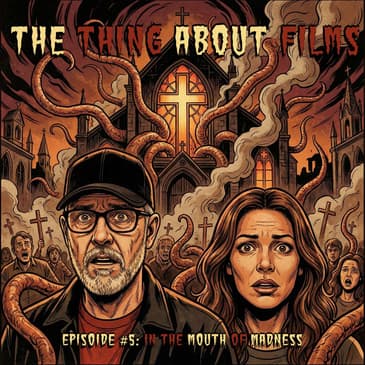
In this episode of The THING about Films, Ambrose is joined by Jessica (because Kelly lost her voice and is officially on vocal rest 💀) for a listener-requested trip straight into John Carpenter’s brain-melter: In the Mouth of Madness (1994).
We’re talking Sam Neill as the world’s most stubborn skeptic, a horror author whose books don’t just scare people—they change people, and a “road trip” to Hobbs End… a town that feels like it was printed out of a paperback and stapled onto reality. Along the way, we hit the wild opening asylum setup, the “Do you read Sutter Cane?” moment, the looping-road nightmare logic, and why this movie still feels weirdly ahead of its time.
Spoiler note: This episode is not spoiler friendly. We get into the full story and the ending.
Follow + Support the Show
Follow the podcast wherever you listen so you don’t miss the next review.
If you enjoyed the episode, leave us a rating/review on Apple Podcasts, Spotify, or wherever you’re listening—it helps more horror fans find the show.
Got a movie you want us to cover? Message us on social and hit us with your request.
Find us on social: @thethingaboutfilms (Facebook, Instagram, TikTok)
VIP PASS (Ad-Free Episodes)
Want every episode ad-free? Join our VIP PASS—the link is in these show notes.
EPISODES FM - _https://episodes.fm/1809836198?view=apps&sort=popularity
Swift - https://www.swiftenergy.gg/products/tropicrush?ref=svalxxsi
Facebook Group Page - https://www.facebook.com/groups/1263899825130479
Blue Sky - https://bsky.app/profile/thethingaboutfilms.bsky.social
Instagram - https://www.instagram.com/thethingaboutfilms/
TikTok - https://www.tiktok.com/search?q=TheTHINGaboutFilms&t=1754605765379
[Ambrose:] Welcome back, everyone. Okay—real quick, you might notice something’s a little different today. Kelly’s out this week because she’s under the weather… and when I say under the weather, I mean she fully lost her voice.
[Jessica:] Ugh, that’s the worst. I feel for her.
[Ambrose:] Same. So yeah—sending Kelly all the good vibes and a very speedy recovery.
[Jessica:] Seriously. Feel better, Kelly!
[Ambrose:] But! We’re not leaving you hanging. Jessica’s stepping in today.
[Jessica:] Heyyy. I’m here. I’m hydrated. I have a voice. Let’s do this.
[Ambrose:] And honestly, the timing works out because this week’s episode is a special one—
[Jessica:] Ooh, why special?
[Ambrose:] Because we’re doing a fan request. Somebody hit us up and basically said, “You have to cover this movie.”
[Jessica:] Okay wait, I love that. So what are we watching?
[Ambrose:] This week, we’re going into the madness. That’s right—today we’re getting way into In the Mouth of Madness.
[Jessica:] Ooohhh. Yeah, okay… that’s a wild pick. I’m excited.
[Ambrose:] Okay, picture this with me. You’re sitting in a dark room. It’s late-late. Like 2… maybe 3 in the morning.
[Jessica:] The witching hour. The “why am I still awake?” hour.
[Ambrose:] Exactly. And there’s a storm outside, just enough thunder to keep jump-scares happening in real life every five minutes.
[Jessica:] And you’re like, “Cool, cool, my house is also part of the movie now.”
[Ambrose:] You’ve got a bowl of popcorn in your lap… but you’re not even eating it anymore.
[Jessica:] Yeah, the popcorn is just… emotional support popcorn at this point.
[Ambrose:] Right, because the movie you’re watching isn’t just trying to scare you. It’s trying to break your brain in half and reassemble it wrong.
[Jessica:] Yeah.
[Ambrose:] That is the exact vibe we’re on tonight.
[Jessica:] It’s such a specific flavor too. It’s not “don’t go in the basement” fear.
[Ambrose:] Mm-hmm.
[Jessica:] It’s the kind of movie that makes you turn to whoever’s next to you and go, “Wait… are we real? Or are we characters somebody wrote into a story?”
[Ambrose:] Which is a horrifying question to be asking at 3 a.m. And yes—
[Jessica:] And yes, that’s exactly the kind of chaos we’re doing tonight.
[Ambrose:] And real quick: this is not gonna be some dry film class situation where we talk about lighting rigs for an hour.
[Jessica:] Thank you.
[Ambrose:] No. This is a ride. You’ve got a horror author whose books literally make people lose it, and you’ve got a detective-ish guy who thinks the whole thing is a scam.
[Jessica:] And a road trip to a town that, by every normal rule of geography, shouldn’t even exist.
[Ambrose:] It’s also not your standard slasher setup. It’s not just a dude in a mask jogging after teenagers.
[Jessica:] No, it’s reality melting. It’s slimy things with way too many tentacles. It’s that feeling like the world is coming apart like a cheap sweater thread.
[Ambrose:] And my favorite part? It treats us—people watching it—like we’re in on it… or we’re part of the problem. Or we’re next.
[Jessica:] Like, “Welcome. You’re not safe either.”
[Ambrose:] So let’s get into it. And we have to start with our tour guide into this mess: Sam Neill.
[Jessica:] Sam Neill plays John Trent. And context matters here. This is 1994. Sam Neill is fresh off Jurassic Park. He’s the face of competence.
[Ambrose:] He’s Dr. Alan Grant. He’s the “I got this” guy.
[Jessica:] Exactly. He’s the guy who saves the kids from the T. Rex. So when you cast him here, your brain goes, “Okay. We’re fine. Sam’s here.”
[Ambrose:] Which makes it so much worse when he falls apart.
[Jessica:] Because Trent isn’t a hero. He’s an insurance investigator.
[Ambrose:] And not like… a sweet one.
[Jessica:] Not at all. He’s a rationalist to the point of being annoying about it. He’s literally paid to not believe people.
[Ambrose:] I love that, though. Because the movie is supernatural chaos, and your main character’s superpower is cynicism.
[Jessica:] It’s perfect. He’s the guy who walks into a “mysterious warehouse fire” and immediately finds the empty gas can and goes, “Aha. Idiot.”
[Ambrose:] He’s a professional skeptic. Which makes him the perfect target for this story, because if you want to break reality… you don’t start with a believer.
[Jessica:] You start with the guy who thinks he’s got reality completely figured out.
[Ambrose:] Exactly. And the movie does not waste time showing us who wins that fight.
[Jessica:] Nope. It basically starts at the end. We see Trent getting dragged into an asylum.
[Ambrose:] And this isn’t “he looks a little stressed.”
[Jessica:] No. He’s screaming that he isn’t crazy. He’s got a black crayon and he’s drawing crosses all over his face, all over the padded walls…
[Ambrose:] That opening hits so hard. Because you see him later in the flashbacks all put together—nice suits, hair slicked back, confident.
[Jessica:] And then cut to him in the padded cell covered in these black crosses, totally unraveled.
[Ambrose:] And immediately you’re like… what could possibly break this guy?
[Jessica:] And those crosses are such a weird, specific choice.
[Ambrose:] Yeah. But, why crosses?
[Jessica:] It feels primal. Like he’s trying to X himself out of existence.
[Ambrose:] Oh. That’s good.
[Jessica:] Or he’s trying to ward something off. It doesn’t even feel like a religious cross. It feels like a cancellation mark. Like he’s trying to cancel the signal from the outside world.
[Ambrose:] That’s upsetting. Like he’s trying to edit himself out of the story.
[Jessica:] Exactly.
[Ambrose:] But before he ends up there, he’s got a job. And that job involves our MacGuffin: Sutter Cane.
[Jessica:] Sutter Cane, played by Jurgen Proch, with this intense, hypnotic presence.
[Ambrose:] Just terrifying energy.
[Jessica:] In the world of the movie, he’s the biggest horror author on the planet. And they are not subtle about it. They literally have somebody say, “Forget about Stephen King.”
[Ambrose:] Kane outsells them all, which is such a bold line. Like, okay, you’re really swinging for it.
[Jessica:] And the thing is, Cane isn’t just an author. He’s… something else.
[Ambrose:] Yeah.
[Jessica:] This is where the movie hits something really interesting about fandom. It’s like Stephen King turned up to 11, but also with a little L. Ron Hubbard vibe.
[Ambrose:] There’s a cult feeling to it.
[Jessica:] A huge cult feeling. We’re talking billions of copies sold. His fans aren’t just readers—they’re basically zealots. It’s bordering on a religion.
[Ambrose:] And the whole plot kicks off because this golden goose vanishes.
[Jessica:] He’s gone. And he took the manuscript for his final book—In the Mouth of Madness—with him.
[Ambrose:] And I think that’s the movie’s big point, right? We say “it’s just a book,” “it’s just a movie,” whatever.
[Jessica:] And this movie is like, “Actually… stories are contagious.”
[Ambrose:] Yes. Like, if a billion people read something and believe it… does it start becoming more real than the world around them?
[Jessica:] That’s the core idea. It’s basically the Tulpa concept from Tibetan mysticism—if enough focus and belief goes into a thought form, it can become physical.
[Ambrose:] So all these readers are pouring so much energy into his nightmares that they start popping into the real world.
[Jessica:] That’s the idea. So naturally, his publisher—played by the absolute legend Charlton Heston—hires our cynic John Trent to find him.
[Ambrose:] And Trent’s first reaction is like, “This is a publicity stunt.”
[Jessica:] 100%. He thinks Cane is hiding in a hotel somewhere laughing while the sales numbers skyrocket.
[Ambrose:] Can we pause on Charlton Heston for a second?
[Jessica:] Please.
[Ambrose:] It’s Moses in a John Carpenter horror movie.
[Jessica:] It really is.
[Ambrose:] It’s wild casting. This icon of old Hollywood, big biblical epics… and here he is playing a sleazy publisher.
[Jessica:] But he brings weight to it. When he tells Trent Cane is missing, you believe it’s a real crisis.
[Ambrose:] And Trent’s like, “Cool. I’m in a detective noir.”
[Jessica:] Meanwhile he’s actually in cosmic horror. Wrong genre. Fully.
[Ambrose:] Completely wrong movie.
[Jessica:] And the signs start early. That diner scene—Trent’s just trying to have a normal conversation, and he looks out the window and sees… the axe maniac.
[Ambrose:] The axe maniac. First crack in the glass.
[Jessica:] This guy crashes through the window. His eyes are bleeding. He’s swinging an axe. And the sound design is so nasty—one second it’s diner chatter, then it turns into this high, screechy dissonance.
[Ambrose:] It’s disorienting.
[Jessica:] And the maniac asks the question that basically hangs over the entire movie.
[Ambrose:] “Do you read Sutter Cane?”
[Jessica:] And then tries to chop Trent into kindling.
[Ambrose:] So right away, we’re like, okay—these books aren’t just “scary stories.” They’re an infection.
[Jessica:] It’s not even “bad ideas.” It’s like the books physically change you.
[Ambrose:] And that’s what’s so scary about it. It shifts the fear from monsters to ideas. Like, if a book can rewire your brain into paranoia and hallucinations…
[Jessica:] Then reading becomes the danger.
[Ambrose:] And it’s even meaner because we’re sitting here watching a story about a story about a book that messes you up.
[Jessica:] The movie is absolutely poking us in the eye. [laughs]
[Ambrose:] So Trent, being Trent, doesn’t let a little axe incident stop him. He starts digging for clues.
[Jessica:] And this is where we get the treasure map sequence. He takes the covers of Cane’s books—cuts them up—and realizes they fit together like a puzzle.
[Ambrose:] I’m not gonna lie, this part is a little bit of a leap for me.
[Jessica:] Oh, it’s total movie logic. “Let me destroy these valuable first editions with scissors.”
[Ambrose:] Right. But it works for the story because it shows Trent getting obsessed.
[Jessica:] Exactly. He puts the pieces together and it forms an outline of New Hampshire. And right in the middle of nowhere is a spot that isn’t on any official map.
[Ambrose:] Hobbs End.
[Jessica:] The fictional town from Cane’s books. And Trent’s like, “Okay, cool, fake town for the stunt.”
[Ambrose:] Like a tourist trap.
[Jessica:] Exactly. So he grabs Cane’s editor, Linda Styles, and they hit the road.
[Ambrose:] And this road trip is where the movie really starts cooking with atmosphere. It’s that “crossing the line” moment.
[Jessica:] Yeah. Leaving the normal world—New York City, logic, money—and heading into the underworld.
[Ambrose:] Exactly. The drive starts normal… and then it gets weird. Lighting shifts.
[Jessica:] The lighting is huge. Carpenter uses those specific blue gels. It’s not quite night, not quite day. It’s like bruised twilight.
[Ambrose:] It makes everything look fake. Like the world’s been printed instead of lived in.
[Jessica:] And the radio starts acting up. But the moment that really tells you we’re crossing over isn’t a monster. It’s the kid on the bike.
[Ambrose:] Oooh, the bicycle boy. We have to talk about this because it creeps me out more than some of the monsters.
[Jessica:] Right. They pass this old-timey kid on a bike on this empty road.
[Ambrose:] And then they pass him again. And again.
[Jessica:] It’s the repetition. It feels like time is looping and the road is folding in on itself.
[Ambrose:] And it’s the little details—the playing cards in the spokes. And the sound gets amplified: thwack, thwack, thwack.
[Jessica:] It’s rhythmic. Hypnotic. And the kid looks… wrong. Like his face is shifting between cuts.
[Ambrose:] It’s that “my brain knows that’s human, but my gut says it isn’t” feeling.
[Jessica:] Exactly. Trent tries to rationalize it—“Oh, it’s just a local kid.” But he’s rattled.
[Ambrose:] He’s absolutely shaken. And then they hit the covered bridge.
[Jessica:] The covered bridge is the portal. Classic horror rule: once you cross, good luck going back.
[Ambrose:] Almost like Sleepy Hollow.
[Jessica:] Yes. They drive into this dark tunnel, screen goes pitch black, and when they come out…
[Ambrose:] Let me guess. The world has changed.
[Jessica:] Precisely. The color palette shifts completely. They’re in Hobbs End. And the town looks… too perfect.
[Ambrose:] Like a postcard. Or honestly, like a movie set.
[Jessica:] kinda of. It’s this Quaint, old-fashioned… and hollow.
[Ambrose:] And you’re like, “Why does this feel empty?”
[Jessica:] Because it’s not a real town with history. It’s a town that exists because a writer described it.
[Ambrose:] What do you mean?
[Jessica:] You know how a book will describe the charming main street, but never mention plumbing, trash pickup, any of that?
[Ambrose:] Yeah.
[Jessica:] Hobbs End feels like that. It only exists as far as the description goes. There’s no “behind the scenes.”
[Ambrose:] That is such a creepy way to put it. Like a façade with nothing behind it.
[Jessica:] Exactly. And then they check into the Pickman Hotel and things go from “weird” to “oh hell no” fast.
[Ambrose:] The Pickman Hotel is a nod to H.P. Lovecraft’s Pickman’s Model.
[Jessica:] Yep. For anyone who hasn’t lived in the horror aisle their whole life—Pickman’s Model is about an artist painting monsters that are actually real.
[Ambrose:] So the movie’s basically telling us, “Art isn’t just imitation. Sometimes it’s documentation.”
[Jessica:] Exactly. And speaking of art—there’s that painting in the lobby.
[Ambrose:] That painting rules.
[Jessica:] It’s a masterclass in cheap scares done right. Every time they walk past it, it changes.
[Ambrose:] First it’s a normal portrait of a couple… then the faces start looking off… then it gets grotesque.
[Jessica:] It’s simple. They just swap the prop painting between takes. But it’s perfect for showing reality is not stable here.
[Ambrose:] And it mirrors how the movie feels. Scene by scene, it gets more warped.
[Jessica:] And Trent and Linda are basically living the book. They start seeing characters and buildings that match Cane’s descriptions exactly.
[Ambrose:] The black church is there, looming over everything.
[Jessica:] And Linda Styles starts losing it first.
[Ambrose:] Because she read the manuscript.
[Jessica:] She knows what’s coming. So she’s freaking out like, “We’re characters.” And Trent is just refusing to accept it.
[Ambrose:] He’s like, “No. That’s an actor. That’s a mask. That’s a special effect.”
[Jessica:] Denial is his armor. Because the second he admits it’s real, his whole worldview collapses.
[Ambrose:] He clings to “hoax” because the other option is… losing his mind.
[Jessica:] And Linda starts noticing the blue eye thing.
[Ambrose:] The eyes. It’s subtle at first, and then it’s everywhere.
[Jessica:] Characters under Cane’s control—characters written by him—have these strange double-pupil blue eyes.
[Ambrose:] It’s like a brand. A stamp. Like ownership.
[Jessica:] And it looks painful, like the eye is splitting.
[Ambrose:] Which takes us right into the practical effects, because this movie is mid-90s peak practical effects.
[Jessica:] We have to talk about KNB EFFECT.
[Ambrose:] Right. Greg Nicotero and his team. Absolute legends. They did The Walking Dead, Army of Darkness, From Dusk till Dawn.
[Jessica:] And they went off on this movie.
[Ambrose:] The scene with Mrs. Pickman—the sweet old innkeeper—
[Jessica:] who is not sweet. Not at all.
[Ambrose:] Trent goes behind the front desk and she’s… I don’t even know how to describe it.
[Jessica:] Tentacles, slime, writhing flesh. It’s a whole situation.
[Ambrose:] And then her husband in the basement, with chopped-up pieces of anatomy that are somehow still alive.
[Jessica:] It’s gross. But in the best way.
[Ambrose:] And this is why practical effects hit different. Mrs. Pickman looks sick. She looks nasty. The light reflects off the slime in a way that still works.
[Jessica:] It triggers the gag reflex. It’s body horror in the vein of The Thing.
[Ambrose:] And it sells the idea that these people aren’t just possessed—they’re being rewritten.
[Jessica:] Yeah.
[Ambrose:] And then we get the biggest set piece: the wall of monsters.
[Jessica:] This is legendary. Trent’s running through this tunnel and he’s chased by—no exaggeration—an 18-foot wall of monsters.
[Ambrose:] It’s like a tidal wave of nightmares. They built this massive rig on wheels.
[Jessica:] And it took, what, like 25 puppeteers to operate?
[Ambrose:] Something like that. Fish people, crab monsters, a cyclops…
[Jessica:] In which they nicknamed one “Meatball.” The Meatball Cyclops.
[Ambrose:] But think about the effort. They could’ve cheated it in a bunch of ways, but instead they built a demon parade float.
[Jessica:] Which makes it feel messy and chaotic. Like a stampede.
[Ambrose:] And Sam Neill is literally running from a real physical thing that wants to crush him. It’s panic you can feel.
[Jessica:] And while all this is happening, we get to the core twist: meeting the author… Meeting God.
[Ambrose:] The “oh, this is what we’re doing” moment.
[Jessica:] Yes. This is the meta twist that makes the movie more than just a creature feature. Trent confronts Sutter Cane in the black church, and Cane lays it out.
[Ambrose:] He’s not just writing books that affect people—he’s rewriting reality.
[Jessica:] And he hits Trent with, “I think, therefore you are.”
[Ambrose:] Which is such a terrifying flip of Descartes.
[Jessica:] Descartes says, “I think therefore I am.” Cane’s like, “Nope. You exist because I wrote you.”
[Ambrose:] And Trent finds out he’s fictional. His skepticism, his job, his suit—everything—was written to push the story forward.
[Jessica:] That’s the real existential horror. Realizing you’re not a person, you’re a character on strings.
[Ambrose:] And Trent fights it. He tries to drive out of town.
[Jessica:] The loop sequence is maddening. He drives away, smashes through the barricade, and then—cut—he’s driving right back into Main Street.
[Ambrose:] Every time.
[Jessica:] North, south, east, west… it doesn’t matter. Every road leads back to Hobbs End.
[Ambrose:] It’s a nightmare. You can’t leave until the author says you can.
[Jessica:] It’s like a video game, where your trying to hit the edge of the map and you just bounce back.
[Ambrose:] And then that bar scene with the locals… the guy who says, “He wrote me this way,” and then… ends it.
[Jessica:] It’s so awful. And that’s what makes it scary—because it’s the horror of having zero free will.
[Ambrose:] It’s tragic. They know they’re puppets and they just want it to stop.
[Jessica:] And Cane gives Trent his mission: he hands him the manuscript for In the Mouth of Madness.
[Ambrose:] Trent’s like, “I’m not doing that.”
[Jessica:] And Cane’s basically like, “Oh, YOU are. It’s already written.”
[Ambrose:] And then Cane tears his own face off. Literally.
[Jessica:] It’s like he’s ripping open a page. And it becomes a portal to the void—where the Old Ones live.
[Ambrose:] Oh man this is pure Lovecraft.
[Jessica:] And the author is just a vessel. A doorway for ancient, chaotic gods to walk into our world.
[Ambrose:] So Trent escapes… or is allowed to escape… back to the “real world.”
[Jessica:] But he’s carrying the infection. He’s carrying the book.
[Ambrose:] And this is where we zoom out a bit, because we have to place this movie in John Carpenter’s career.
[Jessica:] Right. Because this is part three of his Apocalypse trilogy.
[Ambrose:] You got the Thing in ’82, Prince of Darkness in ’87, and In the Mouth of Madness in ’94.
[Jessica:] And they’re not narrative sequels. You don’t see McReady fighting vampires in movie three.
[Ambrose:] But thematically, they’re absolutely siblings.
[Jessica:] If you put them together, it’s like the end of humanity on three levels. The Thing is biological apocalypse—loss of self, loss of your body. You can’t trust your own blood.
[Ambrose:] The body goes first.
[Jessica:] And then you have Prince of Darkness, which is spiritual or scientific apocalypse—loss of soul, loss of order.
[Ambrose:] And In the Mouth of Madness…
[Jessica:] You have Philosophical apocalypse. Loss of reality. Loss of truth.
[Ambrose:] It argues that if enough people believe in a fake reality. You know Cane’s reality. Well, that fake reality becomes the truth.
[Jessica:] And that hits kind of hard now, doesn’t it?
[Ambrose:] It really does. It feels weirdly ahead of its time. Information silos, conspiracy theories, viral ideas, the internet…
[Jessica:] Yeah. If enough people believe a fake news story, that story still impacts the world like it’s real.
[Ambrose:] The movie’s basically saying reality is just… group agreement.
[Jessica:] And there’s that line: sane and insane could easily switch places if the INSANE were to become the majority.
[Ambrose:] Wow. That line is brutal.
[Jessica:] And that’s the scariest thing in the movie for me. Not the monsters. But the idea that sanity is a numbers game.
[Ambrose:] So, if everyone else goes off the rails, you’re the “crazy” one for staying normal.
[Jessica:] Pretty much. And Carpenter wraps all of this in a big Lovecraft homage. The title plays off At the Mountains of Madness. You’ve got cosmic horror, ancient gods, forbidden knowledge, humanity being insignificant.
[Ambrose:] Even the names—Mrs. Pickman, the Old Ones. It’s a love letter to that whole style.
[Jessica:] But modernized. Not dusty libraries—paperback bestsellers and movie adaptations.
[Ambrose:] And it’s also commentary on toxic fandom before we even called it that.
[Jessica:] Oh, totally. Cane’s fans are violent, obsessive. They lose themselves in it.
[Ambrose:] It’s basically saying media consumption can consume you right back.
[Jessica:] Right. So let’s hit the endgame. Trent gets back to New York. He thinks he destroyed the manuscript.
[Ambrose:] He tossed it out the window of a bus. He’s like, “Cool, I saved the world.” But—
[Jessica:] Of course he didn’t.
[Ambrose:] He goes to the publisher—Charlton Heston—and Heston looks at him like he’s nuts.
[Jessica:] Trent says, “I didn’t deliver the book.” And Heston’s like, “What are you talking about? You delivered it months ago.”
[Ambrose:] It’s been on the bestseller list for weeks. The movie adaptation is coming out.
[Jessica:] Trent lost time. The book is out. The infection has spread. Society is collapsing.
[Ambrose:] We get reports of mass violence, mutations, chaos…
[Jessica:] The Old Ones won.
[Ambrose:] And Trent snaps. He ends up back in the asylum where we started.
[Jessica:] But now we’re caught up. The asylum is abandoned. The world outside is basically done.
[Ambrose:] Trent walks out of his cell, through empty corridors, and into a ruined city.
[Jessica:] Post-apocalyptic smoke, rubble, nobody around. It’s like that empty city feeling—like 28 Days Later.
[Ambrose:] And where does he go?
[Jessica:] It’s funny you ask. He went to the movies.
[Ambrose:] Oh right—he finds a movie theater, and what’s playing? In the Mouth of Madness… starring John Trent. Like, excuse me?
[Jessica:] And he doesn’t even hesitate. He walks right up like it’s a normal Tuesday, buys a giant bucket of popcorn from a concession stand that absolutely should not be stocked…
[Ambrose:] Like who is restocking during the end of the world?
[Jessica:] Right? But he just goes with it—grabs his popcorn, walks in, and sits down like, “Alright, let’s watch my life fall apart.
[Ambrose:] And then the screen comes on and it’s him. Like, it’s literally his story—scene after scene, everything we just watched—playing right back at him like the movie is closing the loop.
[Jessica:] Exactly. It confirms he’s a character.
[Ambrose:] And he starts laughing. But it’s not a happy laugh.
[Jessica:] Nope. It’s hysterical. It turns into weeping, then back to laughing.
[Ambrose:] And I’ve always debated this ending. Is he laughing because he’s finally broken… or is it something else?
[Jessica:] I think he’s broken. I think he’s realizing how cruel it all is.
[Ambrose:] See, I read it a little different. I don’t think it’s just “look how messed up this is.” I think it’s… relief.
[Jessica:] Relief?
[Ambrose:] Yes. He’s been fighting for control this whole movie. He’s trying to prove he has free will. And in that moment, he realizes he never had it.
[Jessica:] And there’s a messed up kind of freedom in that. Right?
[Ambrose:] Yeah. The struggle is over. He can just sit there and eat popcorn.
[Jessica:] That is dark. You’re saying he’s embracing being a puppet.
[Ambrose:] What else can he do? The world’s over. He’s the only audience member left for his own tragedy.
[Jessica:] So, every moment of fear… every fight… was basically for the audience.
[Ambrose:] Pretty much. It was for our entertainment. And he’s laughing at us too.
[Jessica:] He absolutely is.
[Ambrose:] Man. That ending sticks with you. It’s bleak, but it’s perfect.
[Jessica:] Mm.
[Ambrose:] Okay, before we wrap, we’ve gotta hit a few fun facts—because the behind-the-scenes stuff on this movie is its own weird little ride.
[Jessica:] Oh, absolutely. Starting with the music.
[Ambrose:] YES. Carpenter’s famous for synth scores—Halloween, Escape From New York, all that minimalist electronic stuff.
[Jessica:] But here, the opening credits come in with this heavy, chugging rock riff.
[Ambrose:] It sounds suspiciously like Metallica.
[Jessica:] don’t you mean it sounds very suspiciously like Enter Sandman. And that was not an accident.
[Ambrose:] Well, I wasn’t going to say all that…but yeah.
[Jessica:] Carpenter wanted Enter Sandman. He loved that heavy drive—it fits the mass-market horror vibe.
[Ambrose:] But I heard the rights were too expensive.
[Jessica:] So what does he do? He calls up Dave Davies from the Kinks.
[Ambrose:] Which is hilarious, because the Kinks are not who you think of for “Metallica energy.”
[Jessica:] But Davies and Carpenter basically wrote a tribute to that vibe.
[Ambrose:] It’s legally distinct… but spiritually identical.
[Jessica:] Exactly. It sets the tone immediately. It’s like, “This is gonna be loud.”
[Ambrose:] And cast-wise, we mentioned Charlton Heston, but there’s also that blink-and-you-miss-it cameo…
[Jessica:] Ahhh a future Sith Lord Christensen Hayden.
[Ambrose:] A very young Aiden. Christensen IS the paperboy in Hobbs End.
[Jessica:] So, before he was Anakin Skywalker, and before he was out there slaughtering younglings, he was delivering newspapers.
[Ambrose:] Talk about range.
[Jessica:] Now, when this movie came out in 1994… it didn’t exactly explode.
[Ambrose:] That’s putting it gently.
[Jessica:] It was a flop. It made something like $8.9 million against an $8 million budget—so it barely breaks even, if that.
[Ambrose:] And critics didn’t go easy on it either.
[Jessica:] Nope. Roger Eber gave it two stars, basically called it a house of horrors with no substance.
[Ambrose:] Which is wild to think about now because it’s loaded with ideas. Why do you think it got missed?
[Jessica:] It’s all about timing. 1994 was a weird spot for horror. Slashers were fading, but the ironic meta horror wave hadn’t hit yet.
[Ambrose:] Yeah, movies like Scream didn’t show up and change the whole vibe until ’96.
[Jessica:] Right. In the Mouth of Madness was doing meta horror before a lot of people knew how to read it. People wanted a monster movie…
[Ambrose:] …and they got philosophy wrapped in tentacles.
[Jessica:] Exactly. But time has been kind to it.
[Ambrose:] Very kind.
[Jessica:] On VHS and DVD it found its audience. Now it’s considered one of Carpenter’s smartest films. Full-on cult classic.
[Ambrose:] It’s a movie that messes with you for watching it… and you still love it.
[Jessica:] And you definitely look at blue eyes a little differently afterward.
[Ambrose:] It really does. And it leaves you with that question—are we the audience, or are we characters in somebody else’s script?
[Jessica:] Don’t do that to me. I have to drive home later. I don’t need to be checking if the road loops back to the studio.
[Ambrose:] Just don’t read the book and you’ll be fine.
[Jessica:] Okay, that’s some solid advice.
[Ambrose:] So that’s our trip into In the Mouth of Madness. We made it through the monsters, the madness, and the bad reviews.
[Jessica:] It’s been a pleasure losing my mind with you.
[Ambrose:] Likewise. Alright, everybody—thanks for listening. Drive safe. Check the back seat. And we’ll catch you on the next one.
[Jessica:] Wait, what? We’re not done yet.
[Ambrose:] Oh, that’s right. We’re just getting warmed up. What was I thinking.
[Jessica:] Yeah what where you thinking…we haven’t even judged it yet. Well, not really.
[Ambrose:] True. The journey’s over, but the verdict’s still out.
[Jessica:] Okay, so I’ve never actually done the Critic’s Crypt thing with you before… but I’m obsessed already. Lead the way.
[Ambrose:] Ok then. Grab your shovels, everybody. We’re heading down to the Critic’s Crypt.
Ambrose: Okay, Jessica welcome to the Critic’s Crypt… and when I say “welcome,” I mean, I’m pretty sure you we’re not expecting this. It’s damp. It’s cold. The lighting is doing absolutely nothing for us.
Jessica: Yeah. For my first time being down here I have to say I now know why Kelly hates it down here. And what’s up with the air, why does it feel wet? And why does it smell like old stones and bad decisions?
Ambrose: That’s the official scent. And before you ask—yes, those are cobwebs. And no, I don’t know what touched your shoulder just now.
Jessica: Don’t… Don’t you say that. I will climb you like a ladder to get out of here.
Ambrose: Fair. But since we’re already trapped down here, we might as well do what we came to do.
Jessica: Right. Judge the movie like two little gremlins in a basement?
Ambrose: Exactly. In the Mouth of Madness. Does it hold up… or is it just nostalgia in a trench coat?
Jessica: Okay, positives first. Because I don’t want to start my first Crypt trip with pure hate. Even though this place is encouraging it.
Ambrose: Alright. My first big win for the movie is the vibe. It makes everything feel wrong, like the world is just… slightly broken.
Jessica: Yes. And it works because it’s not just relying on jump moments. It’s more like, “Hey, you know reality? What if it was fragile and insane all at the same time.”
Ambrose: Exactly. It’s the kind of movie where nothing is happening and you still feel tense.
Jessica: Like the bicycle boy scene. That scene is so simple, but it freaks me out every time.
Ambrose: Oh I know what you mean. Because it breaks the rules. They pass him, then pass him again, then again—and your brain is like, “Oh cool, we’re in a loop now.”
Jessica: And the sound with the cards in the spokes—thwack thwack thwack—like it’s trying to hypnotize you.
Ambrose: It’s so effective. And it proves the movie can scare you without throwing a monster at your face every three minutes.
Jessica: And the practical effects still look nasty in the best way.
Ambrose: Yes. Mrs. Pickman behind the desk?
Jessica: That whole moment is… gross. It looks nasty. It looks like if it touched you, you’d need a shower and a priest.
Ambrose: It looks like it smells bad.
Jessica: It looks like it lives in a basement and pays rent in slime. But that’s why it works—because it feels physical. You believe it’s in the room.
Ambrose: And Sam Neill. That casting is sick, in a good way. Because he’s the “competent guy.”
Jessica: Yeah, he has that face where you’re like, “Okay, he’ll figure it out.” And then the movie slowly takes that away from you.
Ambrose: And he commits. He doesn’t do “mildly stressed.” He goes full unraveling.
Jessica: Which makes it land. Like by the end you’re not questioning it. You’re like, “Yeah, I’d lose it too.”
Ambrose: Okay, your turn—give me a positive you love.
Jessica: The whole concept of stories as an infection. That idea rules. The books don’t just scare people—they change people.
Ambrose: The “Do you read Sutter Cane?” moment is such a punch because it’s not about belief, it’s about consumption.
Jessica: Exactly. And it works because it makes reading feel dangerous. Like if you’ve ever read something and it sticks in your head for days? The movie is like, “What if it stuck so hard it rewired you.”
Ambrose: And it’s extra scary because we’re watching a movie about a story about a book that messes with reality.
Jessica: It’s like the movie is looking at you like, “You sure you wanna keep going?” Which… no. But also yes.
Ambrose: And Hobbs End as a setting. I just love it. That town feels like a fake memory.
Jessica: Yes. It’s too neat. Too staged. Like a postcard that someone printed from a description instead of a real place.
Ambrose: The hotel painting changing is such a simple gag but it does so much. You start questioning what you just saw.
Jessica: Which is the whole point of the movie.
Ambrose: True…Alright. Negatives. Because we can’t pretend it’s perfect. And also because the Crypt demands balance.
Jessica: The Crypt is listening. I can feel it.
Ambrose: Okay. My biggest negative is pacing. And I’m not saying slow is automatically bad. I’m saying there are stretches where it feels like the movie is repeating itself a little too long.
Jessica: Yes. Like the “trying to leave town” loop—great idea, but it goes on one loop too many.
Ambrose: Exactly. First time is scary. Second time is like, “Oh no.” Third time is like, “Okay, yes, I get it. We’re trapped.”
Jessica: What would’ve fixed it? Trim a couple minutes and keep the same point. It would hit harder and feel tighter.
Ambrose: Another one for me is the “book covers make a map” clue.
Jessica: Oh my god, yes.
Ambrose: It’s fun movie logic, but he just immediately starts cutting them up like, “I am a genius,” and I’m like, “Sir, those are collectibles.”
Jessica: It would’ve worked better if he had one extra breadcrumb. Like Linda says something that hints the covers connect. Just one nudge so it doesn’t feel like psychic scissors.
Ambrose: Exactly.
Jessica: My other negative is… some of the dialogue goes a little big. Like it leans into that mid-90s theatrical vibe.
Ambrose: The “I’M NOT INSANE!” energy?
Jessica: Yes. And listen—Sam Neill makes it work because he’s committing. But a couple lines tip into “okay, we are performing.”
Ambrose: I’ll push back slightly though. I think the big-ness is part of the pulp vibe. It’s supposed to feel like a paperback cover came to life.
Jessica: I agree with that… when it’s controlled. When it goes too far, it pulls you out. What would fix it? Just dial a couple lines down like 10%. Same emotion, less stage.
Ambrose: Fair. Also, some of the creature designs—amazing overall—but if you pause, a couple look a little foam-y.
Jessica: The wall of monsters is incredible, but yeah, some pieces get a little parade-float if you stare too hard.
Ambrose: Which is why you don’t stare too hard.
Jessica: Exactly. What would fix it? Darker lighting and faster movement. Don’t give my eyes time to clock the seams.
Ambrose: Right. Okay. Ratings. Because my fingers are freezing and I want to earn our way back upstairs.
Jessica: Same. My toes are numb. Proceed.
Ambrose: I’m giving In the Mouth of Madness 4 out of 5 coffins.
Jessica: Okay, that makes sense. Why 4?
Ambrose: The concept is killer, the mood is strong, the practical effects still hit, and Sam Neill carries the whole thing. It drags in a couple spots and there’s some movie-logic leaps, but it still sticks with you.
Jessica: I’m also at 4 out of 5 coffins.
Ambrose: Wow. Your first time and there’s unity in the Crypt.
Jessica: Don’t get used to it. But yeah—same reasons. The “stories as infection” idea rules, Hobbs End feels like a wrong dream, and the movie commits. I dock it for repetition in the middle and a couple lines going full theater kid.
Ambrose: “Full theater kid” is brutal. You’re gonna get haunted for that.
Jessica: Honestly, I already feel haunted, so whatever.
Ambrose: So yeah. It crawls out of the coffin. It lives.
Jessica: Unfortunately. And if I see a blue light down here, I’m sprinting.
Ambrose: If you hear a whisper “Do you read Sutter Cane?” just know that was not me and run for your life.
Jessica: Deal. Okay—can we leave now? I understand why Kelly hates this place.
Ambrose: Yep. Let’s climb back out before the lights die and we start hearing whispers that sound like our own voices.
Jessica: Yeah I don’t love that idea. So onward Crypt boy before we are stuck down here forever.
[Ambrose:] Okay, we’re back up top. Fresh air. Lights that actually work. And I still feel like In the Mouth of Madness rewired my brain a little.
[Jessica:] I agree. I walked out of the Crypt and immediately looked at the hallway like it was gonna loop me right back down there.
[Ambrose:] Honestly, if I turned a corner and ended up back in the Crypt, I would’ve laid down and accepted it.
[Jessica:] Of course you would. And then you would of asked the Crypt if they had any snacks.
[Ambrose:] Well, I can’t say your lying there. All I’m saying is this movie plants that little thought in your head like, “Hey…what if reality is optional?” That would make anyone suspicious of everything.
[Jessica:] Yeah, exactly. Like once that idea shows up, it’s over. Now you’re sitting there side-eyeing your own life like, “Wait… is this real? Or is this just the movie messing with me?” And then suddenly every little thing feels sketchy for no reason.
[Ambrose:] Exactly…But okay if you had fun with us this episode. Do us a favor and follow the show wherever you are listening on. Also hit the subscribe button so you don’t miss any upcoming movie reviews in the future.
[Jessica:] And if you can give us a review on Apple Podcasts, Spotify, or wherever you’re listening. It genuinely helps us reach more Horror fans just like you. We read all post and reviews. This episode was brought to you by a listener who wanted us to review In the Mouth of Madness. So if you have a movie you like for us to review send us a message on our social media’s.
[Ambrose:] And while your there follow us on Facebook, Instagram, and TikTok. And if you love short fun facts you should follow us on Instagram and TikTok as we post short stories everyday on those platforms. You can find us @thethingaboutfilms
[Jessica:] And if you want to listen to our show ad free, well all you have to do is Subscribe to our exclusive VIP PASS. This is where you will get every episode ad free. Which honestly is the best way to listen. Especially when the episode is the brain-melty. You can find the link in our show notes.
[Ambrose:] So, Jessica I want to say thank you for filling in for Kelly this week. I hope you had as much fun as I did. And let us know how Jessica did. [laughs] I’m pretty sure she would love to read those reviews.
[Jessica:] Awww, thank you. Yes it was fun. And your right I would love to know what you thought, because who knows you might hear me in later episodes…
[Ambrose:] Ooooh, clever. I like how you snuck that in there.
[Jessica:] Hey a girl can dream right.
[Ambrose:] There’s nothing wrong with dreaming.
[Ambrose:] Okay…thank you all for listening and just remember if your street starts feeling like Hobbs End…
[Jessica:] Turn around immediately
[Ambrose:] Or laugh and eat popcorn. Either way…thanks for listening.
[Jessica:] Bye, everybody.
[Ambrose:] Until next time… byeeeee.