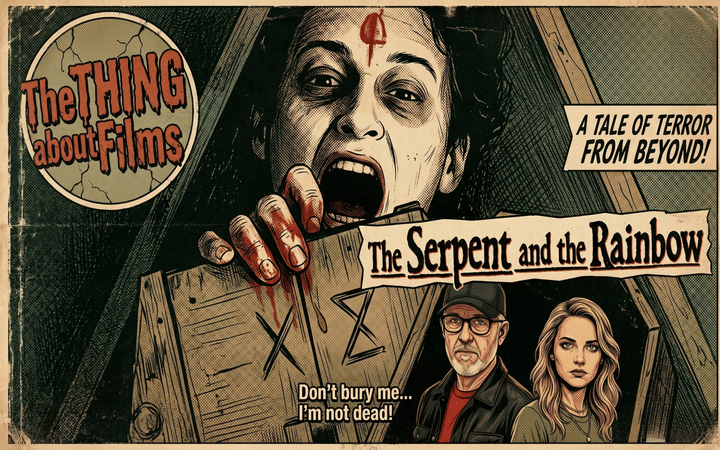
There's a line in The Serpent and the Rainbow where Bill Pullman's character screams — silently, from inside a coffin, while a tarantula crawls across his eye — "Don't bury me... I'm not dead!"
He's paralyzed. He can feel everything. He just can't move.
That image? That's not science fiction. That's a documented phenomenon that a real Harvard scientist went to Haiti to investigate. And somehow, the making of this movie is almost as terrifying as the movie itself.
The Serpent and the Rainbow (1988) is a Wes Craven horror film that doesn't get nearly enough credit. It's part Indiana Jones adventure, part political thriller, part supernatural fever dream — and it's built on a foundation that's stranger than anything Craven could have made up.
What's the Movie Actually About?
Dr. Dennis Alan (Bill Pullman) is a Harvard ethnobotanist — basically, a scientist who studies plants used in rituals. He gets hired by a pharmaceutical company to travel to Haiti and track down a legendary "zombie powder." Not because they care about the magic. Because they want to bottle it as a surgical anesthetic.
So far, so corporate-evil. But once Alan gets to Haiti, things get complicated fast.
He meets Dr. Marielle Duchamp (Cathy Tyson), a local psychiatrist who helps bridge the gap between Western medicine and Haitian Vodou tradition. She takes him to a mental asylum where he finds a man named Christophe — a man who was declared dead, buried, and then showed up alive in his village 18 years later. And he's not okay. He's a shell. He barely speaks. He stares at nothing.
He is, by every measure, a zombie. Just not the kind that eats brains.
Alan digs deeper. He finds Mozart (Brent Jennings), a local bokor — a kind of sorcerer-for-hire — who's willing to sell him the zombie powder formula for $500. That's where things go sideways. Because Alan's investigation catches the eye of Captain Dargent Peytraud (Zakes Mokae), the head of the Tonton Macoute, Haiti's brutal secret police. And Peytraud is not just a soldier. He's a sorcerer too. And he is not happy that this American is poking around.
What follows is a full descent into nightmare. Peytraud invades Alan's dreams. He has his men break into Alan's hotel room and leave symbols of death. And then — in the film's most infamous scene — he straps Alan to a chair and drives a nail through his scrotum while calmly saying, "I want to hear you scream."
Alan gets thrown out of the country. But he can't stay gone. Marielle is in danger, and the country is on the edge of revolution — the real-life fall of Jean-Claude "Baby Doc" Duvalier is happening in real time around him. He goes back.
And then Peytraud blows the zombie powder in Alan's face.
Alan collapses. He can feel everything. He's declared dead. He's placed in a coffin and buried alive. The camera puts you inside that coffin with him, and it is deeply, genuinely horrible in the best possible way.
The final act goes full supernatural — think a wizard battle with fireballs and jaguar spirits — and yeah, it gets a little messy. But by then, the movie has already done something rare: it made you care about the rules of its world, and it made you feel what it means to lose your body while keeping your mind.
Behind the Screams: Filming a Horror Movie During a Real Revolution
Here's where things get truly wild.
The movie was filmed on location in Haiti in 1987 — not on a backlot, not in a studio dressed up to look like Haiti. The actual country. Which was, at that exact moment, in the middle of a violent revolution against the Duvalier regime.
The crew lasted 11 days.
After riots, threats, and a government notice that they could no longer guarantee the safety of the production, the entire cast and crew had to charter a plane and flee to the Dominican Republic. They shot the rest of the film there.
Think about that. They were filming a movie about the Tonton Macoute secret police while the actual Tonton Macoute was still operating in the streets around them.
And that's just the logistics.
Co-screenwriter Richard Maxwell traveled to Haiti for research and reportedly met with a bokor. After that meeting, he had what can only be described as a complete mental breakdown. He didn't recognize his own family. He had to be flown back to the United States for treatment. He later said his soul had been "tampered with."
Bill Pullman spent much of the shoot sick with a high fever — likely from dysentery or something similar — and at one point hallucinated a green cow with television screens for eyes while on set. That became a running joke, but it also tells you something about what conditions were like.
Then there's the actual film work.
The burial scene, which is the heart of the movie, was shot by building a coffin with a glass side so the camera could film Pullman from the perspective of the earth. The "blood" that fills the coffin in the nightmare sequence? A thick, sticky mixture that Pullman had to be submerged in for hours. And the tarantula crawling across his eye? That was a real spider. No CGI. Pullman had to lie perfectly still while a large tarantula walked across his open eyeball.
The effects crew — Lance and David Anderson, who would later become key figures at KNB EFX Group — also built a mechanical puppet for the sequence where a corpse bride vomits a python. The initial shot used the puppet. The python crawling out afterward? That was a real snake.
The film was made for somewhere between $7 and $10 million. It made just under $20 million at the domestic box office — solid, but not spectacular. It found its real audience on VHS and cable, which is honestly the proper place for a movie like this to live.
The True Story Behind the Zombie Powder
This is the part that separates The Serpent and the Rainbow from every other zombie movie.
The character of Dennis Alan is based on Wade Davis, a real Harvard ethnobotanist who actually went to Haiti in 1982 to investigate the case of Clairvius Narcisse — a man who had genuinely been declared dead at a hospital in 1962 and showed up alive in his village in 1980. Davis wrote a non-fiction book about his investigation, which became the source material for the film.
Davis's theory was that zombification wasn't magic. It was chemistry.
Specifically, he believed a "zombie powder" was used by secret Haitian societies called the Bizango. The active ingredient? Tetrodotoxin — a potent neurotoxin found in pufferfish that blocks the signals nerves use to fire. In high enough doses, it drops your body temperature, slows your breathing, and reduces your vital signs to the point where a standard medical examination might declare you dead.
The powder also reportedly contained crushed bones, dried toads, and plant matter. But the tetrodotoxin was the key. Davis believed the powder was absorbed through the skin, induced a death-like state, the person was buried, and then dug up by the bokor and given a second drug — Datura, also known as Jimson Weed — which causes severe disorientation and compliance. The "zombie" was then kept in a drugged, brain-damaged state and used as forced labor.
So the real horror isn't a monster. It's a person who was targeted, chemically paralyzed, buried alive while conscious, and then enslaved. And according to Davis, this was a real enforcement mechanism used by secret societies to punish people who violated community laws.
Now, Davis's science has been disputed. Other researchers have questioned whether tetrodotoxin in that form could actually create such a reliable death-like state. But the real-world case of Clairvius Narcisse has never been fully explained away either.
Davis himself was famously unhappy with the film. He wanted a serious drama — something closer to a political thriller that actually examined what Vodou meant to Haitian culture. What he got was Wes Craven. And while he served as a technical advisor, he publicly disowned the finished film, calling the supernatural third act a betrayal of the material.
What It's Really About
On the surface, The Serpent and the Rainbow is about a scientist who goes looking for a drug and gets way more than he bargained for. But underneath that, it's a movie about power — and what happens when power is used to strip people of themselves.
Zombification in this film isn't about mindless monsters. It's about control. The zombie is a victim, not a predator. To be a zombie is to have your agency taken away, to be trapped in your own body while someone else uses it. That's the film's central horror, and it maps directly onto the political reality of Haiti under the Duvaliers — a government that used fear, violence, and even supernatural mythology to keep the population in line.
Peytraud, the villain, is literally a member of the secret police who also practices sorcery. The film doesn't separate the political evil from the supernatural evil. They're the same thing. And there's something genuinely smart in that idea: that a dictator's real power isn't just guns and prisons — it's the fear that he might be something more than human.
Alan's arc follows the classic pattern of the Western rational mind running into something it can't explain. He comes to Haiti wanting a molecule — a chemical formula he can put in a pill. By the end, he can only defeat Peytraud by fully embracing the spiritual logic of the world he tried to reduce to science. The jaguar spirit he encountered in the Amazon at the beginning isn't window dressing. It's the thing that saves his life.
The film has also been criticized — fairly — for its "white savior" framework. Alan, the white American, comes to Haiti and defeats the great evil. But it's worth noting that the film ends not with Alan's triumph but with the Haitian people's revolution. Duvalier falls because the people rise up. Alan is a participant, not the cause. Whether that's enough to address the critique is a conversation worth having.
How It Was Received — Then and Now
In 1988, the reviews were mixed.
Roger Ebert gave it three out of four stars and praised it for treating Vodou with more seriousness than most horror films of the era. He liked that it wasn't just another slasher. Other critics, though, felt the film lost its nerve in the third act — that the jump from grounded political thriller to supernatural wizard battle broke something that the first two-thirds had carefully built.
The New York Times called it "sensationalist." And honestly, they weren't wrong about the ending. The film does fall apart a little once fireballs start flying.
But here's the thing: audiences found it anyway. On VHS, on cable, at midnight screenings — The Serpent and the Rainbow built a loyal following over the years. A 2016 Collector's Edition Blu-ray release from Scream Factory sparked a proper reappraisal, and since then the film has been recognized as one of Craven's more ambitious and overlooked works.
Today it's seen as a bridge between Craven's raw early films (The Last House on the Left, The Hills Have Eyes) and his later, more polished work (Scream). It tried to do something genuinely different — blend action, romance, political drama, and horror in a way that almost no other mainstream horror film of the 1980s attempted. That it doesn't fully succeed in all four modes doesn't make it less interesting. In some ways, it makes it more interesting.
Horror Fan Corner: The Stuff You Probably Don't Know
There's a rumored cut of this film that runs about 184 minutes — more than three hours. Reports from production insiders and Fangoria magazine suggest this version was a much more deliberate drama, with deeper character work between Alan and Marielle, more political texture around the revolution, and a different ending where Peytraud is brought down by the revolution itself rather than a magical duel.
Universal Pictures wanted a horror movie to compete in the market. They got a three-hour art film and mandated cuts. The studio-mandated supernatural battle ending is almost certainly not what Wes Craven originally intended, and definitely not what Wade Davis wanted. Whether the longer cut still exists somewhere in a Universal vault is one of those persistent horror nerd questions with no good answer.
A few other things worth knowing:
The scene where a woman eats a glass goblet was not a special effect. It was filmed during a real possession trance, and she actually consumed the glass.
Zakes Mokae, who plays Peytraud, was a South African stage legend known for his anti-apartheid work with playwright Athol Fugard. He later appeared in Craven's Vampire in Brooklyn (1995).
This was Bill Pullman's first lead role in a horror film. He'd just come off Spaceballs (1987). The distance between those two films is genuinely impressive.
The film is often compared to White Zombie (1932), the Bela Lugosi film that also dealt with Haitian plantation zombies. The Serpent and the Rainbow is widely considered the modern update of that concept.
Final Thoughts
The Serpent and the Rainbow is a messy, ambitious, genuinely strange movie that tries to do more than it probably should — and lands enough of it to matter.
The premise alone is worth the price of admission: a real story, a real drug, a real revolution, and a production so chaotic that the screenwriter may have lost his mind in the process. Wes Craven took all of that raw material, filtered it through his love of dream logic and practical effects, and made something that still holds up as one of the most unique zombie films ever made.
It's not a perfect film. The third act gets wobbly, the "white savior" framing is a legitimate conversation, and Wade Davis has basically been cursing its name for 35+ years. But the burial scene alone is one of the most effective horror sequences of the entire decade. And the central idea — that the real monster isn't a rotting corpse, but the person who turned you into one — hits harder than anything a flesh-eating ghoul could ever manage.
We covered The Serpent and the Rainbow on TheTHINGaboutFilms — go check out the episode if you want to hear us spiral about zombie powder, Bill Pullman's scrotum, and whether or not Wes Craven actually believed in Vodou by the time production wrapped.
Short answer: something happened on that set.