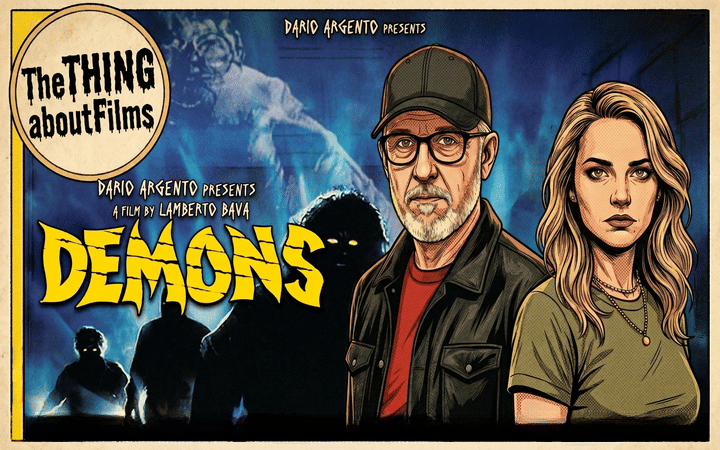
There's a moment in Demons — about an hour in, when things have already gone completely off the rails — where a guy gets on a dirt bike, grabs a samurai sword, and rides through a theater full of monsters while Accept's "Fast as a Shark" blasts on the soundtrack. No setup. No explanation. Just pure, joyful chaos.
That moment tells you everything you need to know about Demons (1985). It's not trying to scare you in a quiet, creeping way. It's trying to grab you by the collar and drag you through the most insane 88 minutes of your life. And honestly? It works.
What Is Demons, Exactly?
Demons is an Italian horror film directed by Lamberto Bava and produced by Dario Argento. It came out in Italy in October 1985, hit the US in 1986, and then basically lived on VHS shelves for the next decade, quietly building one of the most devoted cult followings in horror history.
The setup is simple and brilliant: a group of strangers gets invited to a mysterious movie screening at a theater called the Metropol. The film they're watching involves a demon mask that turns people into monsters. And then — in the lobby, before the movie even starts — someone tries on a demon mask. Gets a scratch. And all hell breaks loose.
That's it. That's the whole engine. A movie about a horror movie making its audience into monsters. It's a self-aware, meta concept a full decade before Scream made that kind of thing fashionable.
The Story: From Creepy Invite to Full Apocalypse
The film opens in Cold War West Berlin. A young student named Cheryl (Natasha Hovey) is on the subway when a guy in a metal half-mask approaches her. She braces for the worst — but he just hands her two free tickets to a preview screening at a renovated theater. She drags her friend Kathy along, and they join a wild assortment of people in the lobby: two college guys, a bickering married couple, a blind man and his niece, and a pimp named Tony (Bobby Rhodes) with two women, Rosemary (Geretta Geretta) and Carmen (Fabiola Toledo).
The lobby is decorated with props that feel weirdly off — a dirt bike, a mannequin with a sword, and a silver demonic mask on a display. Rosemary picks up the mask and puts it on her face as a joke. Tony makes her take it off. But when she pulls it away, it leaves a tiny scratch on her cheek.
That scratch is everything.
By the time the movie starts screening, Rosemary isn't feeling well. She slips into the bathroom, and the scratch has become a massive, pulsating boil. It bursts. Green fluid goes everywhere. And then, in what might be the greatest transformation sequence in 1980s horror, Rosemary becomes a demon — fangs, claws, red eyes, the whole package.
Her friend Carmen runs to check on her, gets attacked, and escapes back into the auditorium — only to collapse and burst through the cinema screen herself, tearing right through the projection during the movie. The film playing inside the film and the real nightmare happening in the theater become one. It's the most perfect visual metaphor Demons has, and it lands like a freight train.
From there, the exits are bricked up. The infection spreads fast. Anyone who gets scratched or bitten turns. The survivors barricade themselves in the balcony. A random group of cocaine-snorting punks breaks in through the back, which makes everything worse. And people die. A lot of people die, in very creative ways.
Tony the Pimp gets one of the best arcs in the film. He takes charge, rallies the survivors, barks commands, and fights back harder than anyone. He goes down swinging, and the audience genuinely feels it.
By the end, only two people are left standing: George (Urbano Barberini) and Cheryl. George spots the dirt bike and sword in the lobby. He gets on. The music kicks in. And the film basically turns into a heavy metal music video for about three glorious minutes.
After that, the two escape through the roof — and find out the demon infection has already spread to the entire city of Berlin. The world is ending. Fade to black. See you in hell.
Behind the Screams: How They Made This Thing
The film came out of a creative partnership between director Lamberto Bava and producer Dario Argento — two of the biggest names in Italian horror at the time. Bava is the son of Mario Bava, the godfather of Italian gothic horror. Argento had already given the world Suspiria and Deep Red. Together, they were basically the Avengers of Italian genre cinema.
The original concept started as a short story Lamberto Bava wanted to put in an anthology film — just a single, terrifying idea about monsters coming out of a movie screen. When the anthology fell apart, he expanded it into a feature. Screenwriter Dardano Sacchetti (the guy behind Lucio Fulci's zombie films) helped build out the story, and then Argento brought in his regular collaborator Franco Ferrini to rework the script. It was reportedly a messy, tense collaboration — Sacchetti says he was paid off and dismissed halfway through, then brought back at the very end to punch up the dialogue. That push and pull between story instinct and pure spectacle is probably why the film has such a strange rhythm: slow and atmospheric for the first twenty minutes, then absolutely relentless for the rest.
They shot on a nine-week schedule, split between the actual streets of West Berlin and a massive interior set built at De Paolis Studios in Rome. The exterior of the Metropol was a real abandoned theater in Berlin. The inside was completely fabricated — every corridor, balcony, and auditorium built from scratch so the crew could destroy it properly.
The special effects were the work of Sergio Stivaletti, who Argento had just used on Phenomena. His directive was simple: disgust the audience as much as possible. He delivered. The transformation sequences — teeth pushing through gums, fingernails peeling back, a demon literally erupting from a woman's spine — were all done with mechanical rigs, foam latex, and carefully rigged puppets. No CGI. No shortcuts. Just craft, gross-out commitment, and gallons of neon-green slime.
The glowing eyes of the demons, one of the most iconic images in the film, weren't expensive post-production effects. Bava and Stivaletti put strips of Scotchlite reflective paper over the actors' eyes and aimed a tight beam of light near the camera lens. The light bounced back, and the effect was captured right there on set.
The soundtrack was another act of genius. Claudio Simonetti of Goblin (who scored Suspiria) wrote the synth score, which pulses and throbs like a heartbeat through the quieter sections of the film. But layered over that is a hand-picked selection of 1980s heavy metal and new wave tracks: Accept, Mötley Crüe, Billy Idol, Saxon. The combination shouldn't work. Somehow it absolutely does.
What It's Really About
Here's the thing: Demons looks like a brainless splatter movie, but it's actually doing something interesting if you pay attention.
The whole premise — a horror movie making its audience into monsters — is a direct shot at the censorship debates going on in the mid-1980s. In the US, the MPAA was cutting horror films to pieces. In the UK, the Video Nasties panic had the government literally banning films and prosecuting distributors. Politicians and social conservatives were claiming that horror movies and heavy metal music were turning the youth into violent, immoral degenerates.
Bava and Argento looked at that argument and basically said: fine, let's make that movie. Let's make a film where sitting in a theater watching horror literally turns people into demons. They gave the censors exactly what they feared — and they cranked it up until it was absurd.
The teenagers snorting cocaine in a stolen car while Billy Idol plays aren't just a random subplot. They're a symbol — the youth the moral crusaders were so terrified of, doing every bad thing at once, and then stumbling into the theater and making everything worse. It's punk rock filmmaking.
The choice of West Berlin as the setting matters too. The city was literally walled in at the time — isolated, surrounded, and full of a disaffected subculture. When the Metropol gets bricked up, it mirrors the claustrophobia of the city itself. And when the infection escapes the theater at the end and floods the streets, it's saying something: you can't contain decay. Not with walls. Not with censorship laws. Not with a bricked-up cinema door.
The Verdict: Then and Now
When Demons hit Italian theaters in October 1985, it was a massive commercial success — grossing over 1.2 billion lire domestically and landing at number 39 on the Italian box office chart for the year. It beat out A Nightmare on Elm Street. It beat out Cat's Eye and Silver Bullet. Italian audiences loved it.
Critics were less enthusiastic. Variety called it colorful but dismissed it as "a thin and finally monotonous slice of grand guignol." Leonard Maltin gave it 1.5 out of 4 stars and cited its "lack of characterizations, logic and plot." Even British critic Kim Newman, while recognizing its entertainment value, called it an "ideal party horror movie" — which honestly sounds like a compliment, even if it wasn't meant as one.
The reappraisal has been significant. Demons currently sits at 75% on Rotten Tomatoes, and modern horror fans celebrate it precisely because of the things critics originally complained about. The breakneck pace. The practical effects. The total refusal to explain itself. It placed at number 53 on Bravo's 100 Scariest Movie Moments. And it's become a staple of horror conventions, midnight screenings, and best-of lists everywhere.
Horror Fan Corner: Trivia Worth Knowing
The silver demon mask at the center of the plot isn't just a cool prop. It's a direct homage to Mario Bava's Black Sunday (1960) — a film that opens with a spiked metal mask being hammered onto a witch's face. Lamberto putting that same kind of mask at the heart of his own film is a quiet nod to his father's legacy.
Michele Soavi, who plays the mysterious masked man handing out tickets, was also the assistant director on the film. Because the shooting schedule was so tight, he was simultaneously directing the "film within the film" cemetery sequences on a separate soundstage while Bava handled the main theater story.
The building used as the exterior of the Metropol still stands in Berlin today. It's now an upscale nightclub called Goya, and it's hosted horror conventions where fans can stand in the same spot Cheryl received her cursed ticket.
In the scenes where survivors try to shove a Coca-Cola vending machine against the doors, the production team was careful to keep the logo turned away from the camera to avoid trademark issues. In a film full of gore, cocaine, and demonic body horror, they drew the line at a soda brand.
And if you've ever played Silent Hill — the 1999 PlayStation game — there's a theater in the foggy town called the Metropol. The developers have cited Demons as a direct influence. Horror lives inside horror, which feels right.
Final Thoughts
Demons (1985) isn't a perfect movie. The plot has holes you could drive a dirt bike through. The punks subplot goes nowhere useful. And if you need your horror to have careful character development and three-act structure, this one's going to frustrate you.
But if what you want is a film that commits completely, that has total conviction in its own chaos, that gives you practical effects that still hold up 40 years later and a soundtrack that makes you feel like you're in a leather jacket in 1985 — this is it. This is the movie.
It's also a genuinely smart piece of meta-horror that predicted the self-aware genre commentary Scream would get credit for a decade later. It just buried that commentary under a dirt bike scene and a demon bursting out of someone's back, because that's the kind of film it wanted to be.
We covered Demons on TheTHINGaboutFilms — go check out the episode if you want to hear us lose our minds over this one in real time.
Meta Description: Demons (1985) is 88 minutes of Italian horror chaos — dirt bikes, demon transformations, and a movie theater that becomes a death trap. Here's everything you need to know.
SEO Tags: Demons 1985, Lamberto Bava, Dario Argento, Italian horror, 80s horror movies, practical effects horror, meta horror, Geretta Geretta, Bobby Rhodes, Sergio Stivaletti, cult horror films, horror movie review