You know a horror movie has done something right when Stephen King tells you not to watch it alone. That's exactly what he said about The Autopsy of Jane Doe — and King doesn't hand out that kind of praise lightly. He called it "visceral horror to rival Alien and early Cronenberg." Guillermo del Toro chimed in too, calling it "well-made, elegant, and powerful."
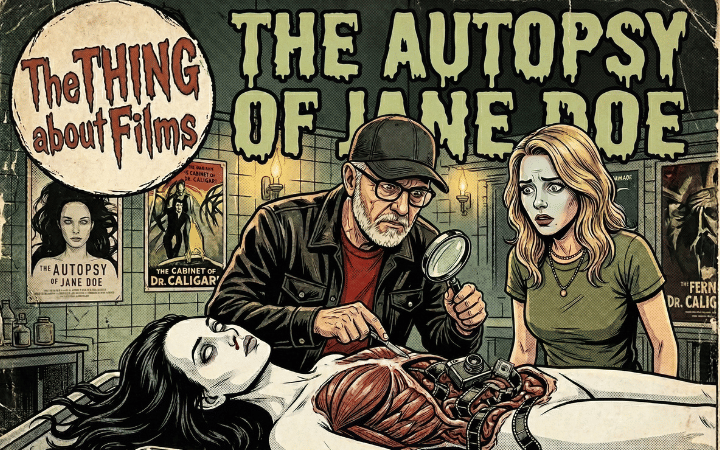
So what's the movie? It's 86 minutes of two guys cutting open a dead woman in a basement. That's it. No haunted houses. No masked killers. No tentacles or demons crawling out of the walls. Just a body on a table, a couple of scalpels, and a slow, creeping certainty that something is terribly wrong. The Autopsy of Jane Doe is one of the most controlled, confident horror films of the 2010s — and if you haven't seen it, this blog is your sign to fix that.
What's Going On Here? The Story, Explained
The film opens at a crime scene. A family has been massacred inside a suburban Virginia home. There's no forced entry. No clear motive. The victims look like they were trying to escape — but from what? Sheriff Burke (Michael McElhatton, aka Roose Bolton from Game of Thrones) needs answers. And then, in the basement, half-buried in the dirt, his deputies find a body.
She's young. She's naked. She's perfect. Not a mark on her. She looks like she's sleeping.
This is Jane Doe.
The Sheriff hauls her over to the Tilden Morgue, run by Tommy Tilden (Brian Cox) and his son Austin (Emile Hirsch). He needs a cause of death by morning — something he can "sell to the press." So Tommy and Austin cancel their plans, roll up their sleeves, and get to work.
What follows is basically a detective story told entirely through an autopsy. And the more they find, the worse it gets.
Her eyes are cloudy — like she's been dead for days. But there's no rigor mortis, which means she died recently. Her waist is impossibly narrow, like she wore a tight corset for years. Her wrists and ankles? Shattered. Pulverized bones, but the skin above them is totally intact, like her body healed over the breaks while they were still broken. When they check her mouth, they find her tongue has been cut out.
Then they open her up. And it gets so much worse.
Her lungs are blackened and charred, like she inhaled fire — but there are no burns anywhere on her skin. Her organs are covered in stab wounds and scar tissue. She was tortured. Brutally, methodically tortured. But on the outside? Not a scratch.
Tommy puts it perfectly: she's a crime scene on the inside.
Then the lights go out. The storm that wasn't supposed to come rolls in fast. The elevator jams. They're trapped in the basement. And then they hear it — the soft, distant jingle of a bell. The kind of bell the Tildens tie to the toes of their other clients to make sure nobody gets buried alive.
The other bodies are out of their drawers. And the night is just getting started.
The Twist That Changes Everything (Spoilers From Here)
By the end of the film, Tommy pieces it together. The jimsonweed flower in her stomach. The cloth with Roman numerals and occult symbols. The shattered limbs. The severed tongue. The year 1693 on the cloth. The Leviticus verse about witches.
She's from Salem. But here's the tragedy: she wasn't actually a witch.
She was an innocent woman who was tortured so brutally by the witch hunters of the time — burned from the inside, crushed, mutilated — that the ritual meant to purge evil actually created it. They made her into the thing they were afraid of. She's been carrying their sins in her body ever since, and anyone who disturbs her pays for it.
The ending doesn't give you any comfort. Tommy tries to sacrifice himself to save Austin, and Jane Doe accepts — but the deal is a trick. Austin dies anyway. When police arrive the next morning, there's no storm. There never was. The morgue is destroyed. Both Tildens are dead. And Jane Doe is pristine again, getting loaded into an ambulance, on her way to a new county. New coroners. New victims.
The final shot is her toe twitching. The radio plays. And she moves on.
Built in a Warehouse, Set in Virginia: The Making of the Film
Here's one of the great behind-the-scenes facts about this movie: it's supposed to take place in rural Virginia, but it was almost entirely shot in East London. The production team rented a 20,000-square-foot warehouse near a Tesco and a Tube line and turned it into a fully operational, deeply creepy morgue.
Why London? Simple. It was cheaper. And that budget stretch went directly into the practical effects and set design that make the film feel so real.
Production designer Matt Gant built the morgue as one continuous, connected set — corridors, elevator, examination room, all physically joined together. This let director André Øvredal shoot long tracking shots that teach the audience the geography of the space. You know exactly where everything is. So when things start going wrong, you feel just as trapped as Tommy and Austin do.
The exterior shots of the Tilden family home were filmed at Home Farm in Kent — a colonial-style farmhouse that could convincingly pass for America. But once you're inside that basement, you're in East London.
Øvredal came into this project off Trollhunter, his found-footage hit, but he wanted to go in the complete opposite direction. He cited James Wan's The Conjuring as a big inspiration — specifically how that film returned horror to atmosphere, dread, and practical craft instead of cheap digital scares. The Autopsy of Jane Doe was his attempt at that same kind of "pure horror." No shortcuts. No CGI monsters. Just a body and two men slowly losing their minds.
The furnace room — which the crew nicknamed "The Pizza Oven" because of its shape and the orange glow it threw across the set — was a practical build. The morgue's lighting relied heavily on fluorescent tubes and surgical lamps, so when the power fails, the darkness hits hard. The crew shot in anamorphic scope (wide aspect ratio), which is a strange choice for a movie set mostly in corridors — but it was a brilliant one. All that dark, empty space on the edges of the frame? That's where your eyes keep drifting, wondering what's hiding there.
What's Really Happening: The Deeper Ideas
On the surface, The Autopsy of Jane Doe is about a witch. But underneath, it's about something a lot more uncomfortable.
Think about what's literally happening in this movie. Two men strip a woman, examine every inch of her body, cut her open, and try to write her story for her. They name her. They measure her. They categorize her damage. They treat her as a puzzle to be solved. And the horror comes, in part, from the fact that she refuses to be solved.
Feminist critics have written about Jane Doe using the concept of "Woman as Absence" — she has no name, no voice (her tongue was cut out), and no agency (she's paralyzed, she's dead, she's on a table). But she dominates the entire film. The men's science can't explain her. Their logic can't contain her. The more they try to understand her, the more she destroys their world. Her power comes entirely from her silence and her refusal to be explained away.
There's also a subtler reading. Jane Doe is "perfect on the outside, destroyed on the inside." That's a pretty clear metaphor for trauma — for the way people can look totally fine while carrying damage that nobody around them can see. And it mirrors the Tilden family itself. Tommy appears stoic after his wife's death, holding it together. Austin seems like a loyal son. But both of them are quietly falling apart. In a way, everyone in this movie is a Jane Doe — carrying things that don't show on the outside.
The film also sets up science against the unknown. Tommy is a rational man. He's spent his career finding logical answers for how people die. Jane Doe breaks every tool he has. And the horror of watching him try to explain away the increasingly impossible events — "it's just the storm," "it's a drafty basement" — is the horror of watching someone's entire understanding of the world come apart at the seams.
How It Landed: Critics, Box Office, and the Streaming Effect
The Autopsy of Jane Doe premiered at the Toronto International Film Festival in September 2016 and landed on VOD and in limited theaters in December of that year. The theatrical box office was tiny — just over $10,000 domestically. Sounds like a disaster, right?
It wasn't. The film was designed as a VOD-first release through IFC Midnight, and it cleaned up on rental charts and streaming platforms. Netflix and Shudder picked it up and introduced it to massive new audiences. It's the textbook definition of a streaming sleeper hit.
Critically, it holds an 86-87% on Rotten Tomatoes with a "Certified Fresh" designation. The Roger Ebert site gave it 3 out of 4 stars, praising Cox and Hirsch for grounding the film in emotional reality. The most common critique is the "two halves" problem — the first hour of slow, methodical autopsy horror is nearly universally praised, while the second half, when things get more chaotic, is sometimes seen as falling back on more familiar haunted-house beats. Still, even critics who had reservations about the ending agreed the setup was exceptional.
And then Stephen King tweeted about it, and everything changed.
The Legacy: What Jane Doe Started
The Autopsy of Jane Doe didn't just succeed on its own — it revived and elevated a whole corner of horror that you could call "clinical horror" or "morgue horror." The idea that the autopsy itself, the cold procedural act of opening up a human body, could be the source of genuine terror? This film proved that in a way nothing quite had before.
The most direct successor is The Possession of Hannah Grace (2018), which follows a lone hospital worker dealing with a female corpse that won't stay dead. The comparisons to Jane Doe are unavoidable — some people love it, some find it a pale imitation. But it wouldn't exist without this film.
Øvredal himself benefited. Del Toro, after praising the film publicly, brought Øvredal on to direct Scary Stories to Tell in the Dark (2019). One great horror movie led directly to another.
And Jane Doe has found a permanent home on "Best Horror of the Decade" lists from outlets like Bloody Disgusting and Dread Central. On horror forums, it's a constant recommendation for people who want something scary without wall-to-wall jump scares. It found its audience. It just took a little time.
Horror Fan Corner: The Weird Stuff You Need to Know
The real actress. Jane Doe is played by a real person — Olwen Catherine Kelly, a model and actress who spent weeks lying perfectly still on a cold marble slab while two men "cut her open." Director Øvredal insisted on a live performer because he felt prosthetics would create distance. With a real human body, every incision feels like a violation. Kelly practiced yoga for years, which gave her enough control over her body that she could take shallow breaths without her ribcage visibly moving. The custom contact lenses that gave her the cloudy-eyed look also left her effectively blind on set, which helped her stay in character.
The bell thing is real history. The bell tied to Jane Doe's toe is a reference to 18th and 19th century "safety coffins" — actual inventions designed for people with taphophobia (fear of being buried alive). A string in the coffin connected to a bell above ground. The phrases "saved by the bell" and "dead ringer" are popularly (though not definitively) linked to this practice. The movie uses it perfectly.
The song is doing a lot of work. "Open Up Your Heart (And Let the Sunshine In)" by The McGuire Sisters (1954) is a religious song about smiling to keep the devil away. Think about that in the context of the movie. The coroners are literally opening up her heart — her chest cavity — and in doing so, they're not keeping the devil out. They're letting it in. That's not an accident.
Martin Sheen was originally cast as Tommy. He had to drop out due to scheduling conflicts. Brian Cox stepped in and made the role so completely his own that it's hard to imagine anyone else in it.
The radio voice changes. Pay attention to the radio announcer as the film progresses. His voice gets slower, deeper, more off. It's subtle enough that you might not catch it the first time — but it's there, and it's one of the most unsettling details in a movie full of them.
Final Thoughts
The Autopsy of Jane Doe is the rare horror movie that trusts its audience completely. It doesn't rush to the scares. It doesn't explain itself too much. It builds, and builds, and builds — and then it pays off in a way that's genuinely sad as well as terrifying.
What makes it stick, even years later, is the witch's backstory. She wasn't evil. She was made evil by people who were afraid of her. The horror they created in trying to destroy her is still out there, still spreading, still taking new victims. That's not just a scary idea for a movie — it's a pretty honest read on how cycles of violence and persecution actually work.
We covered The Autopsy of Jane Doe on TheTHINGaboutFilms — go check out the episode if you want to hear us lose our minds over Olwen Kelly's performance and argue about whether the ending sticks the landing. It's a good time.
And if you haven't seen the movie yet, watch it. Just maybe not alone.
King's orders.