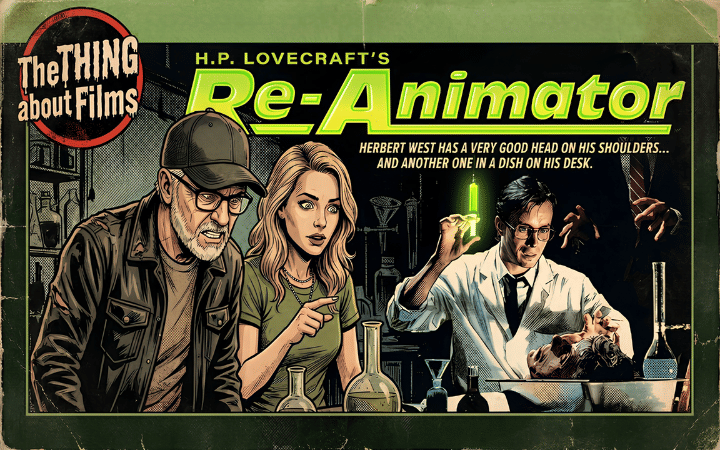
Re-Animator (1985) is the kind of movie that doesn’t just end when the credits roll. It lingers. It clings. It’s the cinematic equivalent of standing up from the couch and going, “Why do I feel… damp?” even though you didn’t spill anything.
In this episode of The THING about Films, Ambrose and Kelly crack open the morgue drawer on one of the most gloriously unhinged splatter classics of the 1980s: Re-Animator. And yes—this is the one with Miskatonic University, medical students with God complexes, a glowing green syringe, and a level of chaos that feels like it should require a permit.
Spoiler warning: This blog post covers the movie and the episode discussion in a spoiler-friendly way.
—
So… why are we talking about Re-Animator right now?
Because time is rude. We’re staring down the barrel of the film’s 40th anniversary, and that’s the kind of information that makes you pause and go, “Cool, didn’t need that today, but thank you, universe.” It’s also the perfect excuse to revisit the movie with fresh eyes—especially with the recent 4K restoration Ambrose and Kelly talk about, which basically turns the movie into: “Oh, you thought that was just a blurry VHS memory? No, babe. Here’s the texture.”
And somehow… it makes it worse. In the best way. The blood looks slicker. The reagent looks brighter. Everything looks more real, which is deeply disrespectful to your comfort.
—
Not “just a zombie movie”
If you go into Re-Animator expecting a traditional zombie movie, you’re going to be confused fast. This isn’t Night of the Living Dead. It’s not modern apocalypse survival horror. At its core, this is a Frankenstein story—about obsession, arrogance, and the idea that the human body is basically a machine you can jump-start if you’ve got the right tools.
Or, in this case, the right amount of neon green juice.
It’s not about the spirituality of death. It’s about the mechanics of life. Which sounds fancy until you watch someone casually treat a corpse like a weekend project.
—
The funniest irony: the original story’s origin is kind of ridiculous
One of the best parts of the episode is the backstory. Because the roots of Re-Animator are way weirder than people expect.
Yes, it’s based on H.P. Lovecraft’s “Herbert West—Reanimator.” And yes, Lovecraft is the “cosmic horror” guy—the ancient gods, the void, the “your brain can’t handle it” fear guy.
And no… he did not love writing this one.
According to the episode, he wrote it as a work-for-hire serial between 1921 and 1922, for a humor magazine called Home Brew. Not a prestigious literary journal. A humor mag. The kind of place where your gruesome horror chapter might be sitting next to jokes about prohibition and recipes for bathtub gin.
And the pay? Five bucks a chapter.
Which explains a lot. Because the serial format forced him into cliffhangers and recaps—basically “Previously on Herbert West…”—and he hated that structure. But that same structure is exactly why Re-Animator works so well as a movie: it naturally escalates. Every chunk has to top the last chunk. The pacing is baked in. Lovecraft accidentally built a horror-comedy pressure cooker while grumbling the whole time.
—
How a Chicago theater guy made an 80s splatter classic
Director Stuart Gordon wasn’t a typical “crank out a cheap slasher” horror director. He came from theater—specifically the Chicago scene—and brought that energy straight into Re-Animator.
The result is a movie that feels different from a lot of its era. It’s staged like a bloody farce. It moves like a dark screwball comedy. The rhythm is sharp, the timing is tight, and the performances feel confident even when everything is going completely off the rails.
One huge reason for that, as Kelly explains, is that Gordon rehearsed the cast for weeks before shooting—like a play. Blocking scenes. Finding the timing. Getting comfortable together. That kind of prep is rare on a low-budget horror set, and you can feel it. When the effects get messy (and they do), the cast can keep going because they know the scene cold.
It’s “the prop failed, so we act harder” energy.
And in a movie like this, that’s survival.
—
Herbert West: not a villain… but definitely the worst roommate alive
Jeffrey Combs as Herbert West is one of those performances you can’t separate from the role. He’s not cackling evil. He’s not doing “monster movie villain” stuff. He’s just… convinced he’s right, and deeply irritated that anyone would question him.
He’s the ultimate nightmare roommate: kills your cat, fills the fridge with body parts, and talks to your girlfriend like she’s an inconvenience. The comedy comes from how serious he is while doing absolutely unacceptable things.
Dan Cain (Bruce Abbott) plays the grounded “normal guy” who gets dragged into the madness, and Megan Halsey (Barbara Crampton) is the emotional anchor—because if you don’t care about at least one person in this mess, it all turns into a gross endurance test.
Also, Dr. Carl Hill (David Gale) deserves a special mention. He’s slimy before the decapitation even happens. And yes—Ambrose and Kelly spend time appreciating the wig, because the wig is doing its own performance.
—
The effects are practical, messy, and kind of unbelievable
This movie is wet. Not metaphorically. Literally.
In the episode, Kelly mentions the production used an absolutely ridiculous amount of fake blood—way beyond what was “normal” for the time. And the reagent? That iconic glowing green stuff? It wasn’t just “movie green.” The way they describe it, it actually glowed on set, which is why it looks so alive on camera.
Then you’ve got headless Dr. Hill—done with old-school camera discipline and practical trickery. Fake torsos. Stunt doubles. Hidden table holes. Lighting designed to hide seams. It’s stage magic with a film camera, and it rules because it feels physical. There’s weight to it. You can tell people built this with their hands.
And the movie’s commitment to gross-out bits is… intense. The cat puppet. The fridge. The finale. The rubber intestines that apparently refused to cooperate, forcing Combs to basically wrestle them into looking dangerous through sheer acting willpower.
It’s disgusting craftsmanship, and that’s part of the charm.
—
Why it’s funny without being a spoof
This is the secret sauce: Re-Animator is hilarious, but it’s not winking at you. The cast plays it straight, which makes the absurdity funnier. Nobody is slipping on banana peels. Nobody is breaking the fourth wall. They behave like all of this makes perfect sense.
Kelly connects this to Grand Guignol—the idea that gore and shock can push an audience so hard that laughter becomes a pressure release. You’re not laughing because it’s a “joke.” You’re laughing because your brain is trying not to short-circuit.
Also: the score. Ambrose and Kelly call it the “Psycho theme on speed,” and once you hear that comparison, you can’t un-hear it.
—
The ratings drama, the different cuts, and why it got messy
Re-Animator has a weird history with censorship and different versions.
In the episode, they talk about how the movie leaned into an unrated release rather than getting boxed in by the ratings board. Later, home video releases got complicated with an R-rated cut that, oddly, can end up longer because of added scenes meant to pad runtime after trims.
If you’re trying to figure out what to watch, the takeaway from their conversation is basically this:
If you want the “party experience,” the unrated theatrical cut is the move.
If you want a “more complete” version out of the different edits, you can explore the other combined cuts they mention—but the lean, mean theatrical version is the one that hits hardest.
—
Content note: the most controversial scene
Ambrose and Kelly don’t dodge the big one: the assault scene involving Dr. Hill and Megan.
Content note: Sexual assault.
They talk about it directly as sexual assault, and they also talk about how the scene is framed—grotesque, upsetting, and meant to horrify rather than titillate. It’s still a lot, and if you’re revisiting the movie (or watching for the first time), it’s worth knowing it’s there.
—
Legacy: sequels, musicals, comics, and a splash zone (yes, really)
Of course it spawned sequels. Of course it did.
They touch on the follow-ups (Bride of Re-Animator, Beyond Re-Animator), and why the original combo of director + cast + tone is hard to recreate. But the wildest legacy detail is the stage musical version—directed by Stuart Gordon—complete with a “splash zone” where audience members wore ponchos because they were getting sprayed with fake blood.
That is either your dream evening… or your worst nightmare. Or both.
They also talk about the comics and crossovers, because Herbert West basically became the go-to mad scientist whenever a franchise wants an excuse to bring someone back.
—
The Critic’s Crypt verdict: Buy it, and here’s the coffin count
After all the history and behind-the-scenes chaos, Ambrose and Kelly drop into their Critic’s Crypt scoring system: Scares, Laughs, and Madness.
Their verdict is basically:
It’s not “sleep with the lights on” scary for modern audiences,
but it is physically intense and uncomfortable in that body-horror way,
it’s genuinely funny,
and the madness level is off the charts.
And the final call?
Kelly says it’s a BUY. Essential classic status.
Coffin ratings:
Ambrose: 5 out of 5 coffins
Kelly: 4 out of 5 coffins (because she has a couple tiny nitpicks and, yes, she stands by it)
—
Before you go: survival rules (and the VIP stuff)
The episode ends the only way it can: Ambrose insisting he would survive the events of Re-Animator, Kelly calmly explaining he would become the cold open, and both of them agreeing on one thing—
Don’t let anyone you know show up with a duffel bag and a plan.
And if it’s glowing?
If it glows, it goes.
If you want to keep up with the show, make sure you follow/subscribe wherever you listen, and leave a quick review if you can—it helps more than you think. And if you want ad-free episodes and bonus content, they’ve got the VIP PASS: $4 a month, or $48 for the year.
Just… maybe don’t celebrate by going anywhere near a syringe.