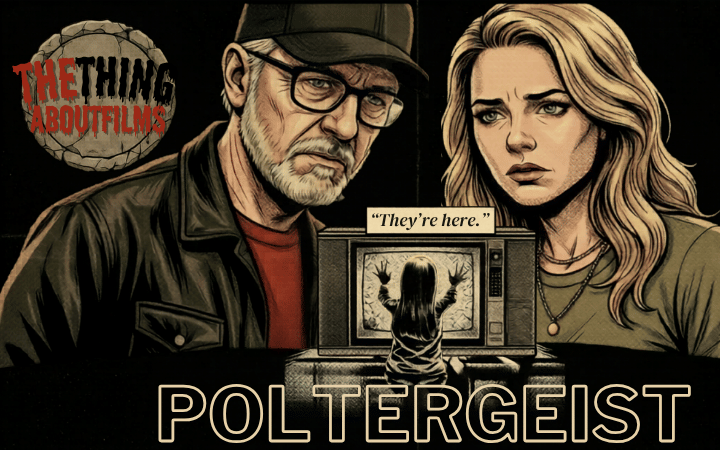
They're here.
Two words. A little girl in pajamas. A TV full of static. And somehow, 40-plus years later, Poltergeist (1982) still gets under your skin in a way that most horror movies only dream about. It's not the scariest film ever made, and it's not trying to be. But it might be the most effective — because it didn't set its story in a crumbling gothic mansion or a fog-drenched cemetery. It set it in a place that looked exactly like where you grew up.
That's the thing about Poltergeist. It came for the neighborhood.
What Happens in Poltergeist (And Why It Still Works)
The Freelings are, on the surface, the perfect American family. Steve (Craig T. Nelson) sells houses in a sunny planned community called Cuesta Verde. Diane (JoBeth Williams) is funny, warm, and keeps the household running while also being clearly the most interesting person in any room. They've got three kids — teenage Dana, nervous Robbie, and little Carol Anne — a dog, a bird, and a house full of the kind of comfortable clutter that makes a place feel lived in.
For a while, the weird stuff is almost fun. Chairs stacking themselves. Carol Anne chatting with the TV static. Things moving around the kitchen like they're doing a little dance. Diane and Steve don't even seem that worried at first — they think it's wild, honestly. Like a haunted house attraction they happen to live in.
Then Carol Anne disappears into the wall, and nothing is fun anymore.
The family can still hear her — her voice coming through the static on the TV — but she's gone somewhere they can't reach. What follows is a full sprint through grief, denial, desperation, and eventually something that plays almost like a rescue mission. The Freelings call in a team of parapsychologists who set up equipment and confirm what everyone already knows: yes, this is very real, and no, they don't know how to fix it.
That's when Tangina shows up.
Zelda Rubinstein's performance as the small, soft-voiced medium Tangina Barrons is one of the great supporting turns in horror history. She walks in, takes one look at the house, and starts talking about the other side with the calm certainty of someone describing the weather. She explains that Carol Anne's life force is so bright that the lost souls in the dimension beyond the house are drawn to her — but so is something else. Something that doesn't want Carol Anne to leave.
The rescue scene — Diane tying a rope around her waist and jumping into a glowing portal in the closet ceiling — is pure chaos in the best way. It's terrifying and strange and weirdly moving, because JoBeth Williams plays it like a woman who has completely run out of fear. She's done being scared. She just needs her daughter back.
And then Tangina delivers the line: "This house is clean."
It is not clean. Not even a little bit.
The final act of Poltergeist goes completely off the rails — skeletons bursting up through the pool, coffins erupting from the ground, a face tearing itself apart in a bathroom mirror, and a house that finally collapses in on itself like a star going nova. It's a lot. And somehow, it all works.
Behind the Screams: Making the Movie
Here's the question that Poltergeist fans never stop arguing about: who actually directed this thing?
Officially, it was Tobe Hooper — the man behind The Texas Chain Saw Massacre (1974) and The Funhouse (1981). Steven Spielberg produced it, co-wrote the script, and came up with the original story. But the persistent rumor — backed up by cast interviews, crew accounts, and a very telling open letter Spielberg published in Variety — is that Spielberg was running the show from the jump.
The legal reason Spielberg couldn't direct was pretty simple: he was under contract with Universal to make E.T. the Extra-Terrestrial at the same time, and that contract said he couldn't direct another feature simultaneously. So Hooper got the credit. But composer Jerry Goldsmith later said he worked primarily with Spielberg on the score. And Zelda Rubinstein said in interviews that Spielberg directed her key scenes.
Hooper maintained until his death that he directed the film, and the Directors Guild of America backed him up — they even fined MGM for sidelining him in the marketing. The truth is probably somewhere in the middle: Spielberg's sensibility is all over the look and feel of the film (those beams of light, those slow awe-struck close-ups on characters' faces), while some of the more brutal, physical horror beats carry Hooper's fingerprints.
What they built together — whether it was a true collaboration or a polite takeover — is one of the most technically impressive practical effects movies ever made.
Industrial Light & Magic handled the effects, and they went all in. For the scene where Diane gets dragged up the wall and across the ceiling, the crew built an entire rotating set — the room literally spun 360 degrees while the camera stayed fixed to the floor. What looks like a woman defying gravity is actually JoBeth Williams sliding down a tilting floor while the furniture comes with her.
The face-peeling scene — where an investigator hallucinates ripping his own face apart — still holds up as one of the nastiest moments in PG-rated movie history. (Yes, PG. We'll get to that.) The effect used a hyper-realistic bust of the actor covered in latex and material that moved and tore convincingly. The hands doing the peeling in close-up? Those are Spielberg's hands. He stepped in to get the shot right himself.
And then there are the skeletons.
For the climactic pool sequence, JoBeth Williams had to swim in a muddy pit surrounded by what everyone on set assumed were rubber props. She found out later — years later, during a legal deposition — that they were real human skeletons, sourced from a medical supply company in India. In 1982, real articulated skeletons were actually cheaper than high-quality rubber replicas. Williams described learning this as a nightmare. It's also, depending on how you look at it, the single most on-brand thing that could possibly have happened during the making of this particular film.
What It's Really About
Poltergeist is a haunted house movie. But it's also very clearly a movie about where Americans were living in 1982, and what they'd buried to get there.
Cuesta Verde — the planned community where the Freelings live — looks like a catalog photo of suburban success. Every house looks the same. The streets are wide and clean. The neighbors are friendly. And the whole thing was built on top of a cemetery where the developers moved the headstones but left the bodies in the ground. Steve Freeling isn't just a victim of this — he's the guy who sells the houses. He's the one who hands over the keys.
That's a choice the film makes very deliberately. Steve is the provider, the protector, the guy who's supposed to have everything under control. And he is completely useless once things go wrong. He cries. He holds the rope while Diane goes into the portal. He weeps in a field and says "I hate this tree" — which, honestly, is a very human thing to do when supernatural forces have kidnapped your child, but still. The film keeps putting him in situations where his tools (money, confidence, physical strength) simply don't work.
Diane is the one who goes in after Carol Anne. Diane is the one who figures out what's happening before anyone else does. And Diane is the one who, by the end of the film, has essentially been through a symbolic death and rebirth right alongside her daughter. The movie argues — quietly but clearly — that the thing strong enough to fight the supernatural isn't money or brawn or even science. It's the specific, almost terrifying force of a mother who isn't going to leave without her kid.
The TV stuff is worth talking about too. The film opens with static. The ghosts first make contact through the TV. Carol Anne disappears through a portal of light that looks an awful lot like a glowing screen. And the very last shot of the movie is Steve shoving the television set out of the motel room onto the balcony. He's done with it. The film treats the TV not just as a spooky detail but as the actual problem — this thing that's been sitting in the middle of the American home, acting as a hearth, a babysitter, a portal to somewhere else. Poltergeist came out in 1982. The timing lands different now.
Critical Reception and the Rating That Changed Everything
Poltergeist was a massive hit in the summer of 1982, earning over $76 million domestically and around $121 million worldwide. That made it the eighth-highest-grossing film of the year — which sounds modest until you realize it was competing against E.T. the Extra-Terrestrial, and that Spielberg was literally competing with himself.
The critical reception was split down the middle. Roger Ebert loved it, calling it a "shocking special-effects sound-and-light show" and praising the way it grounded the supernatural in a real, loving family. Gene Siskel thought it was silly and felt the effects swallowed the human story whole.
But the bigger cultural conversation was about the rating. Poltergeist was originally given an R by the MPAA. Spielberg and Hooper appealed, arguing there was no excessive blood or nudity, and the board agreed — the film got a PG. Parents took their kids. Kids had nightmares for years.
Ebert's critique of the rating stuck: "If I had seen this movie when I was seven, I would have been afraid to go to bed until I was 12." He wasn't wrong. Poltergeist, along with Gremlins and Indiana Jones and the Temple of Doom in 1984, was considered too intense for young children but not graphic enough for an R. That tension is a big part of why the PG-13 rating was created in 1984. Poltergeist helped break the system just by existing.
Its influence on the genre is enormous. The suburban haunting template that Poltergeist established — loving family, normal house, something wrong under the surface — shows up directly in the Insidious series, Paranormal Activity, and The Conjuring. The Duffer Brothers have said repeatedly that Poltergeist was a primary influence on Stranger Things — a child pulled into another dimension, communicating through lights and static, while their mother tears the world apart to find them. Joyce Byers owes a lot to Diane Freeling.
Horror Fan Corner: The Stuff They Don't Tell You
The clown scene almost became a genuine on-set tragedy. The animatronic arms of the clown doll constricted too tightly around actor Oliver Robins' neck during filming. He started choking for real and screaming that he couldn't breathe. Spielberg thought the kid was improvising a brilliant performance — until he saw him turning purple and ran over to pull the arms apart.
Jerry Goldsmith's score was nominated for an Academy Award. It lost to E.T. — which was composed by John Williams, who is usually Spielberg's first call. Goldsmith's work on Poltergeist is underrated: "Carol Anne's Theme" is a gentle children's choir lullaby that becomes genuinely disturbing by the end of the film just through association.
The "Poltergeist Curse" is real in the sense that it happened, even if it's not real in the supernatural sense. Dominique Dunne, who played the oldest daughter Dana, was murdered by her ex-boyfriend just five months after the film came out. She was 22. Heather O'Rourke, who played Carol Anne, died during the filming of Poltergeist III at age 12 from a congenital intestinal blockage that had been misdiagnosed as Crohn's disease. Two other cast members from the sequels also died between films. The deaths are real. The curse is up to you.
Real skeletons in the pool. We mentioned it. But it's worth saying again: real human skeletons, purchased from a medical supplier, used as film props, while JoBeth Williams swam directly through them and had no idea. When she found out, she said she felt sick. Honestly, fair.
Final Thoughts
Poltergeist (1982) isn't just a great horror movie. It's a time capsule — a document of exactly what suburban America was afraid of at the start of the Reagan era, wrapped in one of the most technically ambitious studio horror films ever produced. It scared a generation of kids, helped reshape the ratings system, and laid the groundwork for basically every haunted-house movie that came after it.
But what it really is, at its core, is a movie about a mother who refuses to let go. Everything else — the clown, the TV, the skeletons, the rotating room, the curse — is just window dressing. The heart of the film is Diane Freeling going into the dark after her daughter. And that, more than any effect or jump scare or piece of film theory, is why it still works.
We covered Poltergeist on the podcast — go give it a listen and see how deep this one actually goes.